Got a tow or impound bill that seems too high? This checker compares each charge on your bill with the maximum rates and rules that state and city regulators publish. It flags anything over the limit or not allowed at all, and it tells you exactly where to complain. We checked every rule against an official source in October 2026 and link that source next to each result.
Disclaimer: TowCars.com is a nationwide towing information and referral service. We don’t tow, dispatch, or store vehicles, and we aren’t responsible for the work, prices, or conduct of any towing company. This tool is an estimate and information only, not legal advice. See our disclosure.
Is my tow bill fair?
Enter the charges from your tow or impound bill. We’ll compare each line with the legal maximums or official rates published for your state or city, flag anything that looks too high or isn’t allowed, and show you where to complain.
3. Your result
Pick your state, choose the tow type and enter the line items from your bill, then tap Check my bill.
Estimate and information only, not legal advice. Rules change and local ordinances can set different limits. Confirm with the agency listed before you rely on a result. TowCars.com is a referral service. We don’t tow or store vehicles and aren’t responsible for any towing company’s prices or conduct.
How to read a tow bill
Most tow and impound bills are built from the same handful of charges. Regulators cap some of them, ban others, and leave the rest alone.
- Tow or hook-up fee. The main charge for towing the car. Many places set a flat maximum for non-consent tows. A few cities and states, including Los Angeles, Seattle (private-property tows) and Colorado (police tows), set an hourly rate instead.
- Drop fee. A reduced charge if you get back to the car before it leaves. Several states cap it, often at about half the tow fee.
- Mileage. Per-mile charges after any included miles. Massachusetts includes the first 5 miles in its $132 maximum.
- Storage. Charged per day or per 24 hours, and sometimes per 12 hours. Some places give you a free period first: 24 hours in Georgia and Virginia, and 6 hours in Florida.
- After-hours or gate fee. A charge for releasing the car outside business hours. It may be capped, limited or not allowed at all.
- Admin, notification and lien fees. Paperwork charges. They are often allowed only after a set time, or only if notice letters were actually sent.
Private-property tows vs. police tows
A private-property tow (also called a non-consent or trespass tow) happens when a property owner or manager has your car removed from a lot, garage or driveway. A police-ordered tow follows a parking violation, an accident, an arrest or a city impound. The two are often regulated by different agencies with different rates, so pick the right type in the checker. If you aren’t sure, the name on the tow receipt and the lot that holds the car usually tell you.
Where the checker has verified rules
| Jurisdiction (main source) | Tow types covered | What we found |
|---|---|---|
| Texas — statewide rules | private property, police-ordered | Dollar caps |
| Texas — City of Houston | private property, police-ordered | Dollar caps |
| California — statewide rules | private property, police-ordered | No dollar cap (rules only) |
| California — City of Los Angeles (LAPD Official Police Garages) | police-ordered, private property | Dollar caps |
| California — San Francisco (SFMTA / SFPD tows) | police-ordered | Dollar caps |
| Florida — statewide rules | private property, police-ordered | No dollar cap (rules only) |
| Florida — Miami-Dade County | private property, police-ordered | Dollar caps |
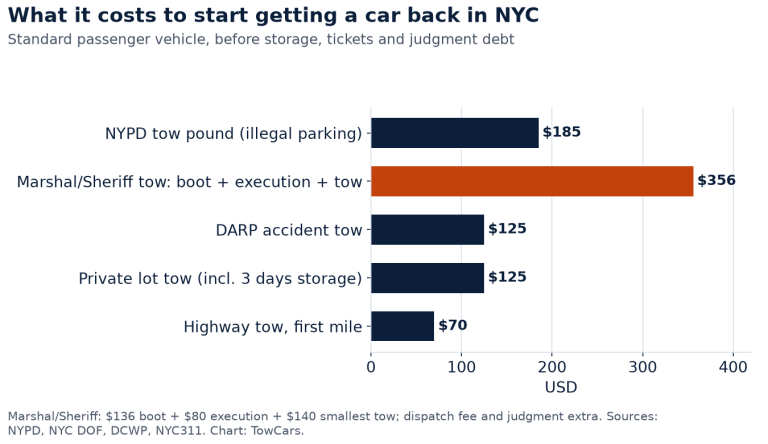
| New York — New York City | private property, police-ordered | Dollar caps |
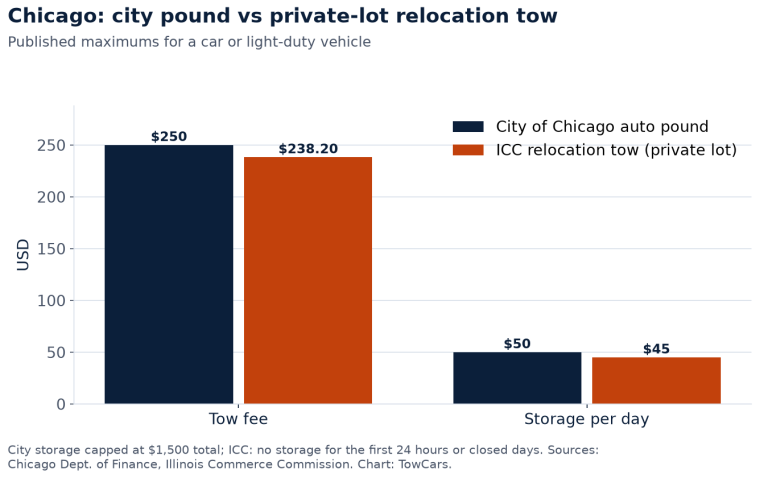
| Illinois — Chicago (city impounds) & Chicago-area private-lot relocation tows | police-ordered, private property | Dollar caps |
| Colorado — statewide (PUC) | private property, police-ordered | Dollar caps |
| Massachusetts — statewide (DPU) | private property, police-ordered | Dollar caps |
| Ohio — statewide (PUCO rule) | private property | Dollar caps |
| Utah — statewide (UDOT 2026 schedule) | police-ordered, private property | Dollar caps |
| Georgia — statewide (DPS Tariff No. 5) | private property | Dollar caps |
| Virginia — statewide (§46.2-1233.1) | private property | Dollar caps |
| New Jersey — statewide rules | private property, police-ordered | No dollar cap (rules only) |
| Washington — City of Seattle | private property, police-ordered | Dollar caps |
| Oregon — City of Portland | private property | Dollar caps |
Signs that a tow bill deserves a second look
- A charge with a vague name such as “service”, “environmental” or “processing” that no posted rate sheet explains.
- Storage billed for the first few hours or the first day, in a place that gives a free period.
- An after-hours fee when you picked the car up during business hours.
- Extra labor, dollies or a flatbed charge on a routine tow from a parking lot.
- No itemized receipt, or a refusal to accept a credit card where the law requires it (for example Texas, Ohio and New York City).
Frequently asked questions
Can a tow company charge whatever it wants?
Not when your car is towed without your consent in a place that caps the price. Texas limits a private-property tow of a light vehicle to $272, Ohio to $144 and Massachusetts to $132, which includes the first 5 miles. In states with no statewide cap, such as California, Florida and New Jersey, the limit comes from local rates or a reasonableness test. When you hire a tow yourself, the price is usually whatever you agreed to.
How much can a tow lot charge for storage per day?
It depends on where you are. Texas caps storage at $22.85 a day for vehicles 25 feet or shorter. Ohio allows $22 a day for light vehicles, and Georgia $33 a day after the first 24 hours, which are free. In Virginia, a car towed from private property can’t be charged storage at all for the first 24 hours. City rates can be higher. Los Angeles official police garages charge $68 a day.
Is a gate fee or after-hours release fee legal?
Sometimes, and often with a limit. Texas doesn’t list a gate or after-hours fee among the charges a storage facility may collect. In California, the after-hours gate fee can be at most half of the company’s hourly tow rate. Virginia allows $30 per instance for night, weekend or holiday service, no more than twice. Georgia caps the fee at $65 and Utah at $75.
What should I do if my tow bill looks too high?
Ask for an itemized invoice that shows each charge and when the car arrived at the lot. Photograph any posted rate signs. Compare each line with the local rules, then file a complaint with the agency that regulates towing where you were towed. The checker above lists that agency for each area it covers. Small claims court is another way to recover an overcharge.
Do I have to pay the full bill to get my car back?
Usually the lot will release the car only after you pay, and storage keeps adding up every day. Many people pay, keep the receipt and dispute the overcharge afterwards. In Texas you can request a tow hearing in Justice of the Peace court within 14 days of the tow. Rules differ by state, so check with the regulator listed for your area.
Does this checker work for a tow I called myself?
Only in a limited way. Price caps generally cover non-consent tows, meaning police-ordered tows and tows from private property. If you called the tow, compare the bill with the price you were quoted and ask the company to explain any charge you didn’t agree to.
How accurate is this tow bill checker?
It compares your bill with official rules and rate schedules that we checked on 2026-10-26. Each result links to its source. Cities and counties can set their own limits, and rates change, so confirm with the agency before you rely on a result. It is information only, not legal advice.
Need a tow you can trust?
If you need a tow now, or want prices from independent towing providers in your area before you book, send us a request.
TowCars.com doesn’t tow vehicles and doesn’t set or guarantee any provider’s prices. This page is an estimate and information only, not legal advice. Rates and rules change, so check with your local authority before you rely on any figure.
Related guides
- How to get your car out of an impound lot
- How to choose a tow company and avoid scams
- How much does a tow truck cost?
- Most expensive U.S. cities and states to get towed (2026 data report)
- Can you stop a tow before it leaves? Drop fees by state
- How much can a tow yard charge for storage per day?
- Do tow companies have to take credit cards? Payment rules by state
- Tow-away sign requirements by state
- Tow yard after-hours and gate fees by state
- Towed from an apartment complex lot: your rights and fee limits