Got towed when you shouldn’t have been? There were no signs, you were parked legally, you were standing right next to the car, or the bill came in way over the posted rates. You can often get your money back. This guide covers what to do in each situation, what we verified about the rules in 14 states, and a free letter generator that writes your refund demand for you.
Disclaimer: TowCars.com is a nationwide towing information and referral service. We don’t tow, dispatch, or store vehicles, and we aren’t responsible for the work, prices, or conduct of any towing company. This page is general information, not legal advice. See our disclosure.
First: is your tow actually wrongful?
A tow can be legal and still feel unfair. The cases below are the ones most likely to get you a refund. Check the rules for your state further down this page.
- Private-property tow without proper signs. Most states that regulate these tows require signs at the entrances that warn you about towing and say who to call. California, Texas, Florida, Massachusetts, Ohio, Utah, Virginia, New Jersey, Washington and Oregon all have sign rules. If the signs were missing, hidden or incomplete, the tow may not have been allowed.
- Towed while legally parked. You were a customer during business hours, a resident in your own space, a guest with a permit, or the time limit hadn’t run out. Take photos of your permit, receipt or meter right away.
- Towed while you were still there, or a drop fee refused. In many states, if you get back before the car leaves the property, the tower has to release it for a reduced drop fee. A tower who drives off anyway, or charges the full price, may owe you money.
- Overcharges. Fees above a posted or legal maximum, storage for a free period, or charges that aren’t itemized. Use our tow bill checker to compare each line with official caps.
- Damage during the tow. Scrapes, bent bumpers, a broken transmission from towing an all-wheel-drive car the wrong way, or items missing from the car. Several states make the tower responsible for damage in transit and storage.
- City or police tow errors. The sign was missing or wrong, the car was reported stolen, the ticket was issued to the wrong plate, or the tow didn’t follow the agency’s own rules. Many cities and states give you a hearing for these tows, but the deadline is short.
How to get your money back, step by step
- Document everything right away. Before anything changes, photograph where you parked, every entrance and sign (or the lack of one), your permit, receipt or meter, and your car from all sides at the lot. Write down the time, names and badge or truck numbers, and get witness contact details.
- Get an itemized bill and the paperwork. Ask for a receipt that lists each charge, the time the car was towed and released, the tow company’s license number, and who authorized the tow. In California, you are entitled to a copy of the property owner’s written authorization before you pay.
- Pay to release the car, under protest. Storage keeps adding up, so it usually makes sense to pay and fight later. Write “Paid under protest” on your copy and keep the card receipt. Inspect the car before you leave the lot, and note any damage on the release form.
- Request a hearing if it was a city or police tow. For public tows, ask for the post-storage or post-tow hearing listed on your notice before the deadline, which can be as short as 5 business days. Bring your photos and receipts.
- Send a written refund demand. Use the generator below to write to the property owner, the tow company or the agency. Ask for a refund (and repair costs) within 14 days, and keep a copy. Certified mail or email gives you proof that you sent it.
- File a complaint with the regulator. Many states and cities license tow companies and take complaints, and some can order refunds. We list the agency for each state below.
- Go to small claims court. If nobody pays, file in small claims. It’s quick and cheap, and you don’t need a lawyer. Bring your photos, receipts, letter and the statute you’re relying on. Limits range from $5,000 to $20,000 in the states below.
Not sure where your car went? Look it up in our impound lot directory. Want to know what a fair tow costs? Try the tow cost calculator.
Free tow refund demand letter generator
Write your tow refund demand letter
Fill in what happened and pick who you’re writing to. The letter updates as you type and cites your state’s rule when we’ve verified one. Everything stays in your browser. Nothing you type is sent or saved.
3. Your letter
Public-tow hearings have short deadlines (for example 10 days in California and Washington, 14 days in Texas, 5 business days in Oregon, and 15 days after release for a Chicago post-tow hearing). Request the hearing the way your notice says, and send this letter as well.
Disclaimer: This generator gives general information, not legal advice. Check the rules where you were towed, keep copies of everything, and talk to a lawyer about your situation if you need advice. TowCars.com is a nationwide towing information and referral service. We don’t tow vehicles.
State-by-state wrongful tow rules
We checked every rule below against the official statute, regulation or agency page in October 2026 and linked the source. Where we couldn’t verify a rule from an official source, we left it out, so a missing item doesn’t mean your state has no rule. Cities and counties often add their own rules, and limits change, so confirm with the agency before you rely on them.
| State | Where to complain or ask for a hearing | Small-claims limit |
|---|---|---|
| California | The local police department and the District Attorney’s consumer protection unit | $12,500 for individuals (Code of Civil Procedure §116.221) |
| Texas | The Texas Department of Licensing and Regulation (TDLR) | $20,000 in justice court (Government Code §27.031) |
| Florida | The county consumer protection office | $8,000 (Florida Small Claims Rule 7.010) |
| New York (New York City) | The NYC Department of Consumer and Worker Protection (DCWP) | $10,000 in NYC Small Claims Court |
| Illinois (Chicago area) | The Illinois Commerce Commission Police | $10,000 (Illinois Supreme Court Rule 281) |
| Colorado | The Colorado Public Utilities Commission | $7,500 (C.R.S. §13-6-403) |
| Massachusetts | The Massachusetts Department of Public Utilities | $7,000 (M.G.L. c.218 §21) |
| Ohio | The Public Utilities Commission of Ohio (PUCO) | $6,000 (ORC 1925.02) |
| Utah | UDOT’s Motor Carrier Division | $20,000 (Utah Code §78A-8-102) |
| Georgia | The Georgia Department of Public Safety | $15,000 in magistrate court (O.C.G.A. §15-10-2) |
| Virginia | The Virginia Attorney General’s Consumer Protection Section | $5,000 (Code of Va. §16.1-122.2) |
| New Jersey | The New Jersey Division of Consumer Affairs | $5,000 (N.J. Court Rule 6:1-2) |
| Washington | The local agency that regulates towing | $10,000 (RCW 12.40.010) |
| Oregon | The local agency that regulates towing | $10,000 (ORS 46.405) |
California
- Signs: Signs at least 17 × 22 inches with 1-inch letters must be in plain view at every entrance. They must say the car will be removed at the owner’s expense and give the local police phone number plus the name and phone number of each tow company (Vehicle Code §22658(a)(1)).
- Owner authorization: The property owner or agent must give written authorization and be present to verify the violation (smaller rentals of 15 units or fewer excepted). You get a copy of the authorization before you pay (§22658(l)).
- Drop fee (you got back in time): If you get back before the car is removed, it must be released. Once it’s hooked up, you can be charged at most half the regular tow fee (§22658(g)(1)(B), (h)).
- Hearing or complaint: City, county or police tows: ask for a post-storage hearing within 10 days of the notice. The hearing must be held within 48 hours of your request (§22852). Private-property tows don’t get this hearing. Use your local police or the District Attorney’s consumer unit instead.
- Penalties and refunds: A property owner who breaks the sign or notice rules owes twice the tow and storage charges (§22658(e)(1)). Towing without proper authorization, or charging more than the allowed rates, can cost the tower four times the charges (§22658(l)(5), (j)(1)).
- Small-claims limit: $12,500 for individuals (Code of Civil Procedure §116.221)
Sources: Cal. Vehicle Code §22658 · Cal. Vehicle Code §22852 · Cal. Code of Civil Procedure §116.221
Texas
- Signs: Signs at each entrance, facing drivers, at least 18 × 24 inches, with the bottom edge 5–8 feet off the ground. They need a towing symbol, the words “Unauthorized Vehicles Will Be Towed at Owner’s or Operator’s Expense”, the days and hours of enforcement and a 24-hour phone number. They must be up when the car is towed and for the 24 hours before (Occupations Code §§2308.252, 2308.301).
- Owner authorization: The tow company needs written verification that the signs were posted. The owner must either request your specific car or have a standing written agreement (§2308.255).
- Drop fee (you got back in time): The state maximum drop fee is $135 for a light vehicle, $190 medium and $244 heavy (TDLR).
- Hearing or complaint: Ask for a tow hearing in justice court in the county you were towed from before the 14th day after the tow (weekends and holidays don’t count), and include photos of the signs. The hearing is held within 21 days. If there was no probable cause, you get reimbursed (§§2308.452–2308.458). You can also complain to TDLR, which can order refunds (§2308.2065).
- Penalties and refunds: A violator owes your damages plus the tow and storage fees. If the violation was intentional, knowing or reckless, add $1,000 plus three times the fees (§2308.404).
- Small-claims limit: $20,000 in justice court (Government Code §27.031)
Sources: Tex. Occupations Code ch. 2308 · Tex. Government Code ch. 27 · TDLR — VSF fees and other charges · TDLR — File a complaint
Florida
- Signs: A sign at each driveway or curb cut, within 10 feet of the road (with no curbs, one per 25 feet of frontage). It needs 2-inch reflective letters saying unauthorized vehicles will be towed at the owner’s expense, “tow-away zone” in 4-inch letters mounted 3–6 feet high, and the tow company’s name and phone. Signs must be up at least 24 hours before a tow. Single-family homes are exempt, and small businesses with 20 or fewer spaces may use a special sign (Fla. Stat. §715.07(2)(a)5).
- Drop fee (you got back in time): If you show up before the car is gone, the tower must stop and return it for no more than half the posted rate (§715.07(2)(a)3).
- Hearing or complaint: Rates must be filed with the local police and posted at the lot. You must get the car back within 1 hour of asking, with a detailed receipt, and you can’t be made to sign a waiver (§715.07(2)(a)6, 9). Complain to your county consumer protection office (Miami-Dade: 311) or the police agency where the rates are filed.
- Penalties and refunds: Whoever improperly causes a tow owes the removal, transport and storage costs, plus damages, attorney’s fees and court costs (§715.07(4)). The tower is liable for damage caused by failing to use reasonable care (§715.07(2)(a)8).
- Small-claims limit: $8,000 (Florida Small Claims Rule 7.010)
Sources: Fla. Stat. §715.07 · Florida Courts — Small Claims · Florida Small Claims Rules (The Florida Bar) · Miami-Dade — Towing regulations
New York (New York City)
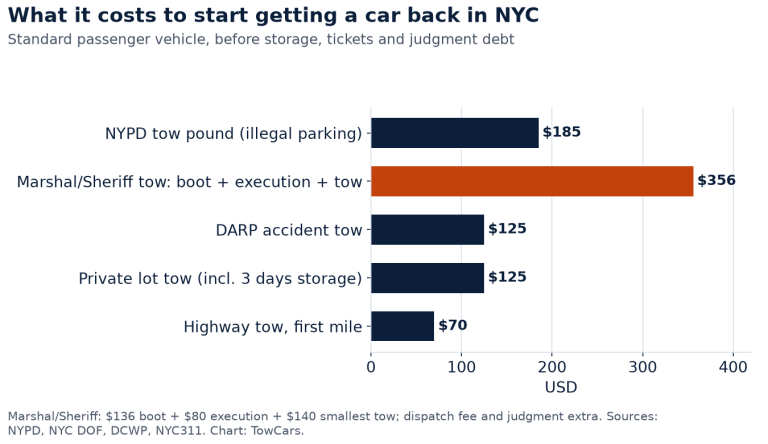
- Drop fee (you got back in time): In NYC, the drop fee is $62.50 if you return before the car is towed. A tow from a private lot is capped at $125, which includes the first 3 days of storage, and licensed tow companies must take credit cards (NYC DCWP).
- Hearing or complaint: Complain to the NYC Department of Consumer and Worker Protection (DCWP) online or by calling 311. Include copies of your receipt so DCWP can mediate or seek a refund.
- Small-claims limit: $10,000 in NYC Small Claims Court
Sources: NYC DCWP — Towing · NYC DCWP — File a complaint · NY Courts — New York City Small Claims Court
Illinois (Chicago area)
- Signs: In Cook, Will, Kane, DuPage and Winnebago counties, signs at least 24 inches high by 36 inches wide must be posted before a tow. They must give the company’s name, address and phone, where the car is taken, the towing fees and the hours if not open 24 hours (625 ILCS 5/18a; ICC).
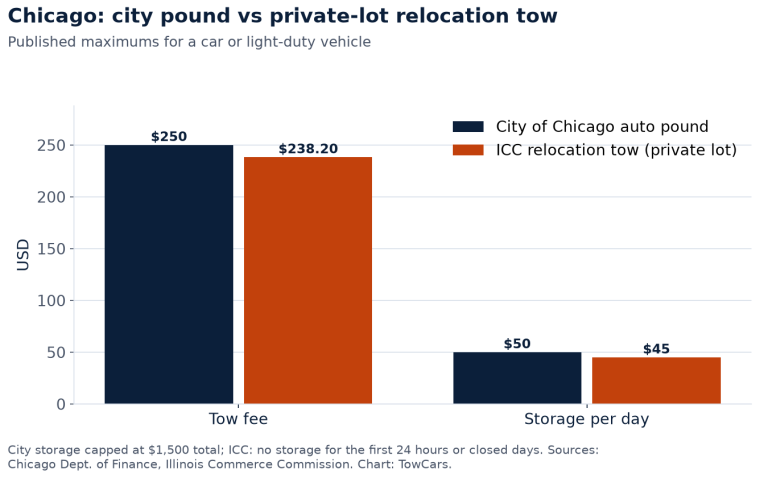
- Drop fee (you got back in time): If you’re there before the car is towed and offer to move it, the company must let you do so immediately. There’s no storage fee if you claim the car within 24 hours (ICC).
- Hearing or complaint: Private relocation tows: complain to the Illinois Commerce Commission Police, (847) 294-4326, using the form on the back of the invoice. Chicago city tows: ask for a post-tow hearing when you pick up the car, or at any auto pound within 15 days of release.
- Small-claims limit: $10,000 (Illinois Supreme Court Rule 281)
Sources: ICC — Relocation towing consumer information (PDF) · ICC Police · City of Chicago — Common towing questions · Ill. S. Ct. Rule 281 (PDF)
Colorado
- Owner authorization: For commercial properties, the business owner or its agent must give written authorization for a tow (Colorado PUC).
- Drop fee (you got back in time): The PUC maximum drop charge is $97.70 for a light vehicle, $125.61 medium and $167.48 heavy. Since Aug. 10, 2022, no drop fee is allowed at all on residential private property (Colorado PUC).
- Hearing or complaint: Complain to the Colorado Public Utilities Commission’s Consumer Affairs staff at 303-894-2070 (option 2), or online.
- Small-claims limit: $7,500 (C.R.S. §13-6-403)
Sources: Colorado PUC — Commercial towing information · Colorado PUC — Towing rates · Colorado PUC — complaint form · Colorado Judicial Branch — Cases for $7,500 or less
Massachusetts
- Signs: A car can be removed only if parking there is forbidden, either directly or by a posted notice from whoever controls the property (M.G.L. c.266 §120D).
- Owner authorization: Before the tow, the property controller must notify the police chief in writing (in Boston, the police commissioner) (c.266 §120D).
- Drop fee (you got back in time): If you appear before the tow is complete, the tower can charge only half its usual fee (c.266 §120D).
- Hearing or complaint: Complain to the Massachusetts Department of Public Utilities (DPU), which sets the maximum trespass-tow rates.
- Penalties and refunds: A tower that hasn’t fully complied must release the car with no removal or storage charges, and charges can’t exceed the DPU maximum (c.266 §120D).
- Small-claims limit: $7,000 (M.G.L. c.218 §21)
Sources: M.G.L. c.266 §120D · M.G.L. c.218 §21 · Mass. DPU — Trespass towing rates · Mass. DPU — Complaint form
Ohio
- Signs: A sign at least 18 × 24 inches, visible from every entrance. It must say it’s a tow-away zone, who may park, the enforcement hours, and the phone number and address where the car can be recovered day or night (ORC 4513.601(A)).
- Owner authorization: The tow company must take photos showing the violation (ORC 4513.601(D)). For homes with three or fewer households, the police or sheriff orders the tow, only after 4 hours (ORC 4513.60).
- Drop fee (you got back in time): If you arrive after the car is prepared for towing but before it’s removed, you pay no more than half the PUCO tow fee and get the car back (ORC 4513.601(C)).
- Hearing or complaint: Complain to the Public Utilities Commission of Ohio (PUCO). When you pick up the car, you must be given notice that you can sue under ORC 4513.611.
- Penalties and refunds: You can sue the tow or storage company for $150 per minor violation and $1,000 per major one, such as refusing a half-fee release (ORC 4513.611).
- Small-claims limit: $6,000 (ORC 1925.02)
Sources: ORC 4513.601 · ORC 4513.60 · ORC 4513.611 · ORC 1925.02 · Ohio Adm. Code 4901:2-24-03
Utah
- Signs: Signs at least 24 × 18 inches at each entrance. Without compliant signs, the car can be towed only with your consent or after a written notice has been on the driver’s window for 24 hours. Exceptions include fire lanes, hydrants, disabled spaces, gated lots and single-family or duplex homes (Utah Code §72-9-603(3), (7)–(9)).
- Owner authorization: On lots towed case by case, the tow company can’t patrol, can’t act as the owner’s agent, and can’t tow without a written or verbal request from the owner or agent (§72-9-603(8)).
- Drop fee (you got back in time): The UDOT 2026 maximum drop fee is $105.50 for a light vehicle, $176 medium and $217.50 heavy.
- Hearing or complaint: You must be given the Utah Consumer Bill of Rights Regarding Towing. No fee can be collected until the tow is reported to the state impound database. Fees must be posted, and cash and cards must be accepted (§72-9-603(1), (2), (15)). Complaints go to UDOT’s Motor Carrier Division.
- Small-claims limit: $20,000 (Utah Code §78A-8-102)
Sources: Utah Code §72-9-603 · Utah Code §78A-8-102 · UDOT — 2026 non-consent towing fee schedule (PDF) · UDOT — Towing complaints
Georgia
- Signs: The state’s maximum rates can be charged only if the property posted notice that unauthorized vehicles will be towed, and the notice must meet DPS Rule 570-38-7-.14. Homes with 4 or fewer units are exempt (DPS Tariff No. 5).
- Owner authorization: Tow companies work under a contract with the property owner. For residential properties of 4 or fewer units, advance signed authorization from the owner may be used instead (DPS Tariff No. 5).
- Drop fee (you got back in time): If the car is hooked up but hasn’t left and you drive it away, the operator fee is at most $130 under 20,000 lb GVWR, or $195 for heavier vehicles (DPS Tariff No. 5).
- Hearing or complaint: Complain to the Georgia Department of Public Safety’s non-consensual towing unit, (404) 624-7242.
- Small-claims limit: $15,000 in magistrate court (O.C.G.A. §15-10-2)
Sources: Georgia DPS — Non-consensual towing tariff No. 5 (PDF) · Georgia DPS — Non-consensual towing · Georgia Courts — Navigating the courts · Georgia Consumer Protection Division — Magistrate court
Virginia
- Signs: Signs at all entrances must clearly say vehicles will be towed. At minimum, they need the local police non-emergency number or the tow operator’s phone (Code of Va. §46.2-1231(A)). Local ordinances may set other rules.
- Owner authorization: The tow must be reported to the police, or storage is limited to one day. Charges above the posted fees can’t be collected (§46.2-1231(B), (C)).
- Drop fee (you got back in time): If you’re there and move the car before it’s actually towed, it isn’t towed, and any fee is capped at $25 unless a local ordinance says otherwise (§46.2-1231(D)).
- Hearing or complaint: Complain to your locality (many have towing ordinances) or the Virginia Attorney General’s Consumer Protection Section. The statewide hookup maximum is $210, and no storage can be charged for the first 24 hours (§46.2-1233.1).
- Small-claims limit: $5,000 (Code of Va. §16.1-122.2)
Sources: Code of Va. §46.2-1231 · Code of Va. §46.2-1233.1 · Code of Va. §16.1-122.2 · Virginia AG — File a complaint
New Jersey
- Signs: A sign at least 36 × 36 inches at each vehicular entrance. It must list when and why parking is allowed, that unauthorized cars will be towed at the owner’s expense, the tow company’s name, address and phone, the charges, the storage address and hours, and the Division of Consumer Affairs number, 1-800-242-5846. Single-family homes and owner-occupied buildings of six or fewer units are exempt (N.J.A.C. 13:45A-31.6).
- Owner authorization: The tow company needs a written contract with the property owner and the owner’s authorization for the tow (N.J.A.C. 13:45A-31.6(a)).
- Drop fee (you got back in time): A car that’s hooked or lifted but not yet removed must be released to you. Only a decoupling fee can be charged (N.J.A.C. 13:45A-31.8(b)–(c)).
- Hearing or complaint: Complain to the NJ Division of Consumer Affairs, 1-800-242-5846.
- Small-claims limit: $5,000 (N.J. Court Rule 6:1-2)
Sources: N.J.A.C. 13:45A-31 (PDF) · NJ Courts — Small claims · NJ Courts — Notice: Rule 6:1-2 limits (PDF) · NJ Division of Consumer Affairs — Complaints
Washington
- Signs: On nonresidential lots, a car parked less than 24 hours can be impounded only if signs near each entrance and on the property show when cars may be impounded and the tow company’s name, phone and address. Residential property can tow right away with written authorization (RCW 46.55.070).
- Owner authorization: The property owner or agent must sign an authorization at the time and place of the impound, and the tow operator can’t sign as the owner’s agent (RCW 46.55.080).
- Hearing or complaint: Ask for a hearing in district or municipal court. Your written request must be received within 10 days of the date the notice was given. If the impound was improper, you pay no fees and can get damages for loss of use plus the filing fee (RCW 46.55.120).
- Small-claims limit: $10,000 (RCW 12.40.010)
Sources: RCW 46.55.070 · RCW 46.55.080 · RCW 46.55.120 · RCW 12.40.010 · Seattle — file a towing complaint
Oregon
- Signs: A clear, conspicuous sign in plain view must prohibit or restrict public parking (ORS 98.854(1)).
- Owner authorization: The lot owner or agent must contact the tower at the time of the tow and sign an authorization, and you can get a free copy on request. The tower can’t sign as the owner’s agent or make you waive your right to dispute the tow (ORS 98.854(2), (3), (10)). The tower must photograph the car before towing, and you can get a free copy (ORS 98.853(1)).
- Drop fee (you got back in time): If you’re there before hookup is complete, the car is released at no charge. After hookup, you pay at most the hookup charge (ORS 98.853(2)(a)).
- Hearing or complaint: Police or public-agency tows: request a hearing in writing within 5 business days of the date the notice was mailed. The hearing is held within 72 hours. If the tow was invalid, you owe nothing and get reimbursed (ORS 819.190). In Portland, private-property impounds are handled by the PBOT Regulatory Program, 503-823-7483.
- Small-claims limit: $10,000 (ORS 46.405)
Sources: ORS chapter 98 · ORS chapter 819 · ORS chapter 46 · Portland PBOT — Towing and private property impounds
Frequently asked questions
Can I get my money back if I was towed illegally?
Often, yes. Start by asking whoever caused the tow (the property owner, the tow company or the agency) for a refund in writing. If they refuse, you can file a complaint with the regulator or sue in small claims court. Some states add penalties on top of the refund. In California, a tower that tows without proper authorization can owe four times the charges. In Texas, an intentional, knowing or reckless violation adds $1,000 plus three times the fees. Ohio allows $150 to $1,000 per violation.
Should I pay the tow bill if I think the tow was wrong?
Usually yes, so storage stops adding up. Pay, get an itemized receipt, and write “paid under protest” on your copy or say so in writing. Paying to get your car back doesn’t mean you agree the tow was legal. In Florida, the tower can’t make you sign a waiver to release your car.
What if I got back to my car before it was towed away?
Many states make the tower release it on the spot for a limited drop fee. California and Florida cap it at half the regular tow charge. Ohio requires a half-fee release. Texas sets a state maximum ($135 for a light vehicle). Colorado lists its rates by vehicle size and allows no drop fee at residential properties.
Who do I sue: the property owner or the tow company?
It depends on what went wrong. Missing or bad signs and a bad authorization usually point to the property owner, who ordered the tow. Overcharges, a refused drop and damage point to the tow company. When you’re not sure, you can name both. In California, an owner who breaks the sign rules owes double the charges, and in Florida whoever improperly causes a tow owes the costs plus damages and attorney’s fees.
How do I fight a city or police tow?
Ask for the tow hearing on your notice, and do it fast. Deadlines are short: 10 days in California and Washington, 14 days in Texas (not counting weekends and holidays), 5 business days in Oregon, and 15 days after release for a Chicago post-tow hearing. If the hearing finds the tow wasn’t justified, you can get the towing and storage charges back.
Is the demand letter generator legal advice?
No. It writes a general-information letter from the facts you enter, and it quotes a state rule only when we’ve checked it against an official source. Nothing you type leaves your browser. For advice on your own situation, talk to a lawyer or your local legal aid office.
Need a tow you can trust?
If you need a tow now, or want prices from independent towing providers before you book, request a free quote.
TowCars.com doesn’t tow vehicles and doesn’t set or guarantee any provider’s prices. This page is general information, not legal advice. Laws change, so check with your local authority or a lawyer before you rely on it.