Tow and impound bills are full of jargon: hook-up fee, drop fee, gate fee, dollies, administrative fee, lien fee. This glossary explains 58 of the terms you’re most likely to see, in plain English. Where a state, county or city publishes a limit or rate for a fee, we show it with a link to the official source, so you can tell a normal charge from one that’s out of line.
Disclaimer: TowCars.com is a nationwide towing information and referral service. We don’t tow, dispatch, or store vehicles, and we aren’t responsible for the work, prices, or conduct of any towing company. This page is information only, not legal, insurance or financial advice. See our disclosure.
Towing terms, fees and charges explained
58 terms you’ll see on tow and impound bills, in plain English, with real fee limits from official schedules where they exist.
No term matches that search. Try a shorter word, or check the fee in the tow bill checker.
A
Accident tow
Also called: Incident tow, crash tow
A tow from a crash scene. It can be a tow you arrange yourself or one ordered by police. Bills often include extra time at the scene and cleanup, and many schedules require that those were actually needed and performed.
Published examples
- In New Jersey, accident extras such as winching and cleanup can be billed only if they were actually performed. Source: N.J.A.C. 13:45A-31 (PDF)
Administrative fee
Also called: Admin fee, processing fee
A paperwork charge from the tow company or storage lot, sometimes called an admin, processing or impound fee. Many fee schedules cap it or allow it only after a set time.
Published examples
- Utah caps it at $44 for non-consent tows. Source: UDOT – 2026 non-consent towing fee schedule (PDF)
- Miami-Dade allows $38.20 on a private-property tow, but only after the first 24 hours. Source: Miami-Dade County – Maximum towing rates (PDF)
After-hours release fee
Also called: Gate fee
An extra charge for picking up your car outside the lot’s normal business hours, often called a gate fee. Some places cap it and others don’t allow it at all.
Published examples
- Georgia caps it at $65. Source: Georgia DPS – Non-consensual towing rate tariff No. 5 (PDF)
- Seattle caps it at $100 on private-property impounds. Source: Seattle – Max towing fees, private property impounds
- In California it can be at most half the company’s hourly tow rate. Source: California Vehicle Code §22658
B
Billable miles
Also called: Loaded miles
The miles you are charged for, usually counted from pickup to drop-off once the car is loaded. Some schedules cap how many miles a non-consent tow can bill.
Published examples
- Colorado caps billable miles on private-property tows at 12 within 10 miles of I-25 and 16.5 elsewhere. Source: Colorado PUC – Towing rates
Boot removal fee
A charge to remove a wheel boot (an immobilizing clamp) instead of towing the car.
Published examples
- Chicago charges $100 to remove a boot from a passenger vehicle. Source: City of Chicago – Towed vehicle information
C
Class A, B, C and D
Also called: Vehicle class
Weight classes that many rate schedules use to price tows. Class A is usually a passenger car or light truck, and higher letters mean heavier vehicles and bigger wreckers. Each schedule defines its own weight limits.
Published examples
- Miami-Dade’s maximum private-property tow runs from $145.00 for Class A to $377.50 for Class D. Source: Miami-Dade County – Maximum towing rates (PDF)
Consent tow
Also called: Owner-requested tow
A tow that you, the owner or driver, ask for, such as a breakdown tow you call in yourself. The price is usually whatever you agreed to, because most legal caps cover only non-consent tows.
Credit card surcharge
Also called: Card fee
An extra percentage added when you pay by card. Some places allow it, some cap it and some ban it.
Published examples
- Utah allows up to 3% of the total. Source: UDOT – 2026 non-consent towing fee schedule (PDF)
- In Georgia, card payments, if accepted, may not carry an extra charge. Source: Georgia DPS – Non-consensual towing rate tariff No. 5 (PDF)
D
Daily storage
Also called: Storage fee
The charge for keeping your car at a lot, billed per day, per 24 hours or in 12-hour steps. It is often the fastest-growing part of a bill, so collect the car as soon as you can.
Published examples
- Texas caps storage at $22.85 a day for vehicles 25 feet or shorter. Source: TDLR – Vehicle storage facility fees
- Los Angeles official police garages charge $68 a day for a standard vehicle. Source: LAPD Board of Police Commissioners – 2026 OPG rates (PDF)
Damage waiver
Also called: Release of liability
A form saying you won’t hold the tow company responsible for damage. You don’t have to sign one to get your car back in some states.
Published examples
- In Florida, the tow company can’t require you to sign a damage waiver. Source: Florida Statutes §715.07
Dolly fee
Also called: Dollies
A charge for using wheel dollies, small wheeled platforms placed under the wheels that stay on the ground. They are used for AWD cars or when a wheel is damaged.
Published examples
- Indian River County, Florida lists dollies at $45. Source: Indian River County (FL) Sheriff – Maximum towing rates (PDF)
- San Francisco charges a $56 dolly fee only if a dolly was needed. Source: SFMTA – Towed vehicles
Drive-line removal
Also called: Driveshaft disconnect
Disconnecting the driveshaft so the drive wheels can turn freely during a tow without damaging the transmission.
Published examples
- Seattle doesn’t allow a separate drive-line removal charge on private-property impounds. Source: Seattle – Max towing fees, private property impounds
Drop fee
Also called: Drop charge, on-scene release fee
A reduced charge when you reach your car after it is hooked up but before it leaves. The company releases the car on the spot and charges this fee instead of the full tow.
Published examples
- Texas caps it at $135 for a light vehicle. Source: TDLR – Towing consumer information
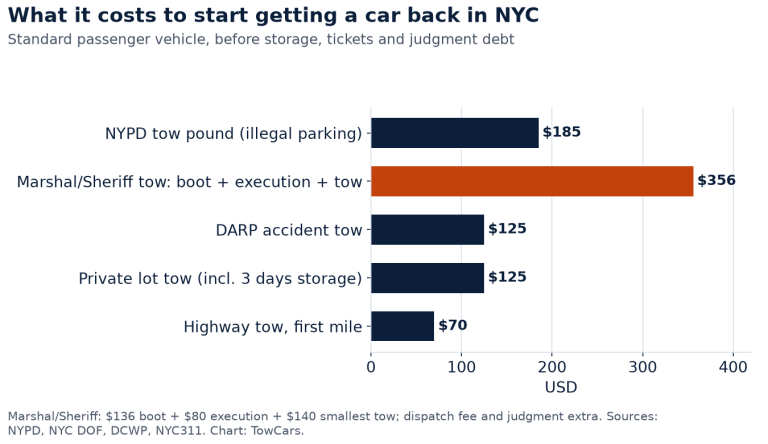
- New York City caps it at $62.50. Source: NYC DCWP – Towing
- Miami-Dade caps it at $72.50 for Class A. Source: Miami-Dade County – Maximum towing rates (PDF)
- In Ohio, you pay at most half the tow fee. Source: Ohio Rev. Code 4513.601
E
Environmental fee
A charge for fluid cleanup or disposal. Look for it on a storage lot bill, because some states don’t allow it there.
Published examples
- Environmental, notary and personal-property access fees are not allowed at a Texas vehicle storage facility. Source: TDLR – Vehicle storage facility fees
EV surcharge
Also called: Electric vehicle fee
An extra charge for towing or handling an electric vehicle, which usually needs a flatbed and extra care.
Published examples
- The Los Angeles official police garage list allows an EV surcharge of up to $77 ($75 if you don’t pay by credit card). Source: LAPD Board of Police Commissioners – 2026 OPG rates (PDF)
Extra labor
Also called: Additional labor
Time charged for additional workers or work beyond a normal hook-up, for example to free a car stuck in a garage.
Published examples
- Massachusetts allows $46 per person-hour for extra labor on a police-ordered tow. Source: Mass. DPU – Involuntary/trespass towing rates
Extra time
Also called: Waiting time, scene time
A charge for time at the scene beyond what the base fee includes, usually billed in 15- or 30-minute steps.
Published examples
- Massachusetts allows up to $51 per half hour after the first hour on police-ordered tows, but not on trespass or snow tows. Source: Mass. DPU – Involuntary/trespass towing rates
F
Flatbed
Also called: Rollback, car carrier
A tow truck with a bed that tilts down so the whole car is pulled up onto it, with no wheels on the road. It’s the safest choice for AWD cars, EVs and low or damaged cars. Also called a rollback.
Published examples
- Indian River County, Florida lists a flatbed call at $155 against $145 for a regular tow. Source: Indian River County (FL) Sheriff – Maximum towing rates (PDF)
Flatbed charge
An extra fee for using a flatbed instead of a wheel-lift. Some rules limit it to cases where a flatbed was really needed.
Published examples
- New Jersey bans a flatbed charge if the car could safely have been towed upright by another truck. Source: N.J.A.C. 13:45A-31 (PDF)
Fuel surcharge
An add-on that adjusts tow or mileage rates for the price of fuel. Where it is regulated, the regulator publishes the allowed amount.
Published examples
- Colorado’s maximum mileage rate including the October 2026 fuel surcharge is $5.15 per mile, against a $3.80 base. Source: Colorado PUC – Towing fuel surcharge
G
Grace period
Also called: Free storage period
The time after a tow when no storage can be charged yet.
Published examples
- Florida doesn’t allow a storage fee if the car is stored for less than 6 hours. Source: Florida Statutes §715.07
- Portland gives a 4-hour grace period. Source: Portland TRN-17.03 – Private property impound fees
- San Francisco doesn’t charge for the first 4 hours. Source: SFMTA – Towed vehicles
GVWR
Also called: Gross vehicle weight rating
Gross vehicle weight rating, the maximum loaded weight the manufacturer sets for a vehicle. Tow rates often switch from light-duty to medium- or heavy-duty pricing at a set weight.
Published examples
- New York City rotation tows cost up to $125 for vehicles of 10,000 lb or less and $140 above that. Source: NYC DCWP – Towing
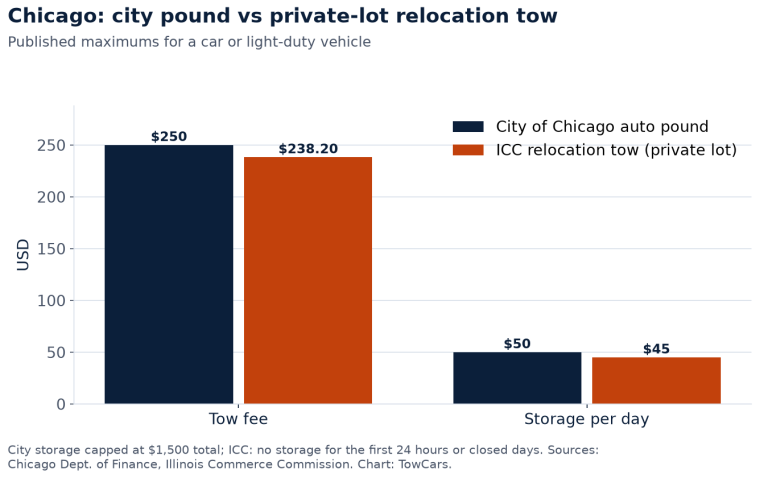
- Chicago charges $250 to tow a vehicle under 8,000 lb to a city impound lot and $350 for heavier vehicles. Source: City of Chicago – Towed vehicle information
H
Heavy-duty tow
Also called: Heavy wrecker tow
A tow of a large truck, bus or RV with a heavy wrecker or rotator. It’s often billed by the hour, so a big recovery can legitimately cost much more than a car tow.
Published examples
- Houston’s heavy-duty police tow rate is $354 per hour with a 2-hour minimum. Source: City of Houston – 2026 tow rates (PDF)
Hook-up fee
Also called: Base fee, hook-up charge
The base charge for sending the truck and attaching your vehicle. It often includes the first few miles.
Published examples
- AAA Club Alliance puts a typical 5-mile tow at $75 to $150. Source: AAA Club Alliance – How far will AAA tow my car?
Hourly rate
A tow priced by the hour instead of as a flat fee, common for police-ordered and heavy-duty tows. Ask for the start and end times on the invoice.
Published examples
- Utah’s 2026 maximum police-generated tow rate is $211 an hour for a light vehicle. Source: UDOT – 2026 non-consent towing fee schedule (PDF)
- Los Angeles official police garages charge $220 for the first hour for a standard vehicle. Source: LAPD Board of Police Commissioners – 2026 OPG rates (PDF)
I
Impound
Also called: Impoundment
When a vehicle is removed and held at a lot, usually on police orders or at a property owner’s request, until the owner pays and proves they own it.
Impound lot
Also called: Tow yard, storage lot, vehicle pound
The yard where towed vehicles are stored until they are released. It may be run by a city, a police department or a private company under contract.
Indoor storage
Also called: Inside storage
Storage in a building instead of an open yard. It usually costs more and is sometimes allowed only when someone asked for it.
Published examples
- Miami-Dade allows indoor storage rates only if the owner, lienholder, insurer or police asked for indoor storage. Source: Miami-Dade County – Maximum towing rates (PDF)
Invoice fee
A small charge for preparing the bill.
Published examples
- The Illinois Commerce Commission allows a $2.50 invoice fee on relocation tows. Source: Illinois Commerce Commission – Relocation towing guide (PDF)
Itemized invoice
Also called: Itemized receipt
A bill that lists each service, its price and when it was done. Ask for one every time. You need it to dispute a charge, and many places require the company to give you one.
Published examples
- California requires an itemized invoice (Vehicle Code §22651.07). Source: California Vehicle Code §22658
L
Lien
Also called: Possessory lien
A legal claim the tow company or lot has on your vehicle for unpaid towing and storage. If the bill stays unpaid long enough, the lien can lead to a lien sale.
Lien fee
Also called: Lien filing fee
A charge for starting the lien process, such as filing paperwork to sell an unclaimed vehicle. It’s often allowed only after the car has been in storage for some time.
Published examples
- Portland allows a lien filing fee only after 5 days in storage: $50, $75 or $175 depending on the car’s value. Source: Portland TRN-17.03 – Private property impound fees
Lien sale
Also called: Lien auction
The sale or auction of an unclaimed vehicle to pay the towing and storage bill, after the required notices have been sent.
Lockout service
Also called: Car lockout
Roadside help getting into a car when the keys are locked inside.
M
Mileage charge
Also called: Per-mile rate
A per-mile charge for the distance towed, usually after any miles included in the hook-up fee.
Published examples
- J.D. Power figures cited by AAA put typical towing mileage at about $2.50 to $7 per mile. Source: AAA Mountain West Group – Roadside assistance guide (cites J.D. Power)
- Massachusetts includes the first 5 miles in its $132 maximum and allows $4.40 a mile after that for a passenger car. Source: Mass. DPU – Involuntary/trespass towing rates
Motorcycle tow
A tow on a flatbed or motorcycle trailer with wheel chocks and straps. Motorcycles shouldn’t be towed with a wheel-lift.
Published examples
- Sarpy County, Nebraska lists a motorcycle tow at $125. Source: Sarpy County (NE) – 2026 towing rates
N
Non-consent tow
Also called: Nonconsensual tow, involuntary tow
Any tow the owner didn’t ask for, such as a police-ordered tow or a tow from private property. Most legal price caps apply to these tows.
Published examples
- Texas caps a private-property tow of a light vehicle at $272. Source: TDLR – Towing consumer information
Notification fee
Also called: Notice fee
A charge for mailing the notices the law requires, such as letters to the owner and lienholder.
Published examples
- Texas allows a one-time $50 notification fee, which isn’t owed if you claim the car before notice goes out. Source: TDLR – Vehicle storage facility fees
- Georgia allows up to $91 in total. Source: Georgia DPS – Non-consensual towing rate tariff No. 5 (PDF)
O
Official police garage
Also called: OPG
A private tow company under contract to tow for a police department, at rates the city sets. Los Angeles uses this term (OPG).
Published examples
- LA’s 2026 OPG rates include $68 a day for storage of a standard vehicle. Source: LAPD Board of Police Commissioners – 2026 OPG rates (PDF)
Overturned vehicle charge
Also called: Rollover recovery
An extra charge for righting a vehicle that is on its side or roof before it can be towed.
Published examples
- Sarpy County, Nebraska adds $150 when the vehicle is on its side or roof. Source: Sarpy County (NE) – 2026 towing rates
P
Personal property retrieval
Also called: Access to personal property
Getting your belongings out of a towed car. Some places require the lot to let you do this for free.
Published examples
- In Ohio you can get personal items out of the car for free with proof of ownership. Source: Ohio Adm. Code 4901:2-24-03
- In Colorado it’s free for cars towed from residential property. Source: Colorado PUC – Towing rates
Police hold
Also called: Investigative hold
When police instruct the lot not to release a vehicle, for example during an investigation. You’ll need a release from the police agency before the lot will give the car back.
Police-ordered tow
Also called: Police tow, law-enforcement tow
A tow ordered by law enforcement, for example after a crash, an arrest, a parking violation or when a car is blocking traffic. Rates are often set by the city, county or state.
Published examples
- Chicago charges $250 to tow a vehicle under 8,000 lb to a city impound lot. Source: City of Chicago – Towed vehicle information
Private-property tow
Also called: Trespass tow, private impound, PPI
A tow from a parking lot, garage or driveway at the request of the property owner or manager. Many states cap the price and require posted signs.
Published examples
- Georgia’s maximum rates apply only if the property had proper tow-away signs (small residential properties are an exception). Source: Georgia DPS – Non-consensual towing rate tariff No. 5 (PDF)
R
Recovery
Also called: Vehicle recovery
Getting a vehicle back onto a road it has left, such as out of a ditch, a ravine, water or deep snow. It’s billed separately from the tow and often by time and equipment.
Release fee
Also called: Vehicle release fee
A government fee for authorizing the release of an impounded car. It’s separate from the tow company’s charges, and you may have to pay it at a police station or city office.
Published examples
- The City of Los Angeles may charge its own vehicle release fee in addition to the garage’s rates. Source: LAPD Board of Police Commissioners – 2026 OPG rates (PDF)
Relocation tow
The Illinois term for a tow from a private lot without the owner’s consent.
Published examples
- The Illinois Commerce Commission caps a light-duty relocation tow at $238.20 in Cook, Will, Kane, DuPage and Winnebago counties. Source: Illinois Commerce Commission – Relocation towing guide (PDF)
Roadside assistance
Help at the roadside without a full tow: a jump-start, tire change, fuel delivery or lockout service. It’s often included with auto club memberships, insurance or new-car warranties.
Published examples
- AAA Classic covers tows up to 5 miles, while Plus and Premier cover up to 100 miles per tow. Source: AAA Club Alliance – How far will AAA tow my car?
Rotation list
Also called: Rotation tow, tow rotation
The list of approved tow companies that police call in turn when the driver hasn’t chosen one. The next company on the list gets the call.
Published examples
- New York City’s accident (DARP) and rotation (ROTOW) tows are capped at $125 for vehicles of 10,000 lb or less. Source: NYC DCWP – Towing
Rotator
A heavy-duty wrecker with a crane-like boom that can turn 360 degrees, used to lift and recover large trucks and buses.
S
Snow tow
Also called: Snow emergency tow
A tow of a car left on a street during a snow emergency or parking ban.
Published examples
- Massachusetts doesn’t allow its extra-time charge on snow tows. Source: Mass. DPU – Involuntary/trespass towing rates
Standby time
Also called: Waiting time
A charge for the truck and driver waiting at the scene, for example while police finish their work. Ask for it to be documented on the invoice.
Published examples
- Portland allows $27 per quarter hour of standby time beyond 30 minutes, and it must be documented. Source: Portland TRN-17.03 – Private property impound fees
Storage facility
Also called: VSF
A licensed lot that stores towed vehicles. In Texas it is called a vehicle storage facility (VSF), and the state limits what it can charge.
Published examples
- A Texas VSF may charge only notification, impound and daily storage fees, plus a government fee in some places. Source: TDLR – Towing consumer information
T
Title lookup fee
The cost of searching state records to find the owner and lienholder so notices can be sent.
Published examples
- Miami-Dade allows the actual title-lookup, postage and advertising costs, up to $250 in total. Source: Miami-Dade County – Maximum towing rates (PDF)
Tow hearing
A hearing in which a judge or hearing officer decides whether a tow was legal. If not, the company may have to refund your costs.
Published examples
- In Texas you can request a tow hearing in Justice of the Peace court within 14 days of the tow. Source: TDLR – Towing consumer information
- In Chicago you can contest a city tow through the Department of Administrative Hearings. Source: City of Chicago – Towed vehicle information
Tow-away sign
Also called: Tow-away zone sign
A posted sign warning that unauthorized vehicles will be towed. Many states require one before a private-property tow is legal, and it often has to show the tow company’s name and phone number.
W
Wheel-lift
Also called: Wheel-lift wrecker
A tow truck with a metal yoke that cradles two wheels and lifts that end of the car, leaving the other two wheels rolling on the road. It’s the most common truck for short tows.
Winch-out
Also called: Winching
Pulling a stuck vehicle out of mud, sand, snow or a ditch with a cable and winch. It’s usually billed by time.
Published examples
- Ithaca, New York lists $100 for the first 15 minutes plus $50 per 15 minutes after that. Source: City of Ithaca (NY) – Towing and storage fees
- Sarpy County, Nebraska lists winching at $100 an hour. Source: Sarpy County (NE) – 2026 towing rates
The examples are maximums or listed rates from the official schedule linked under each one, checked October 26, 2026. They apply only in that place and to the tow types the schedule covers, and they change, so open the source before relying on a number. Where no example is shown, we didn’t find a published rate we could cite.
How to use this glossary on a real tow bill
- Ask for an itemized invoice. Every charge should be listed separately, with dates and times. California, New Jersey and Texas all require specific details on the bill.
- Find out what kind of tow it was. A tow you asked for (a consent tow) is priced by agreement. Police-ordered and private-property tows (non-consent tows) are the ones most likely to have legal caps.
- Look up each line. Use the search box or the A–Z links above to find each fee, then check whether your state or city lists it as allowed and what the cap is.
- Compare the totals. Enter the charges in the tow bill checker to compare them with published limits, or use the tow cost calculator to estimate what a tow you arrange yourself should cost.
- Act fast. Storage is charged by the day, and many dispute deadlines are short. In Texas, for example, you have 14 days to request a tow hearing.
Charges to look at closely
These lines are the most common source of disputes, because many places limit or ban them on non-consent tows:
- After-hours or gate fees, which aren’t allowed at Texas storage facilities.
- Administrative fees, which Miami-Dade allows only after 24 hours and New Jersey only after more than three trips to the car.
- Environmental, notary and personal-property access fees, which aren’t allowed at Texas storage facilities.
- Extras such as dollies, winching and drive-line removal, which Seattle doesn’t allow on private-property impounds.
- Storage charged for the first hours, which isn’t allowed during the grace period in Florida, Portland or San Francisco.
Frequently asked questions
What fees can a tow company legally charge?
It depends on where you were towed and on the type of tow. Many states and cities cap non-consent tows, such as police-ordered and private-property tows, and list which fees are allowed. Texas, for example, lets a vehicle storage facility charge only notification, impound and daily storage fees, plus a government fee in some places. Tows you arrange yourself usually aren’t capped, so agree on the price first.
What is a gate fee on a tow bill?
A gate fee, or after-hours release fee, is an extra charge for collecting your car outside the lot’s business hours. Where it’s regulated it’s often capped. Georgia caps it at $65, and in California it can’t be more than half the company’s hourly rate. Texas storage facilities aren’t allowed to charge a separate gate fee.
What is a drop fee?
A drop fee is what you pay if you get back to your car after it’s hooked up but before it’s towed away. Instead of the full tow, the company releases the car for a reduced fee. In Texas the maximum is $135 for a light vehicle, and in Ohio and California it is at most half the tow charge.
How do I check if my tow bill is too high?
Get an itemized invoice, look up each line in this glossary, then enter the charges in our tow bill checker. It compares them with the published limits for 18 states and cities and links to each official source.
Need a tow you can trust?
Tell us where the car is and where it needs to go, and we’ll pass your request to independent towing providers in your area.