AI-generated illustration
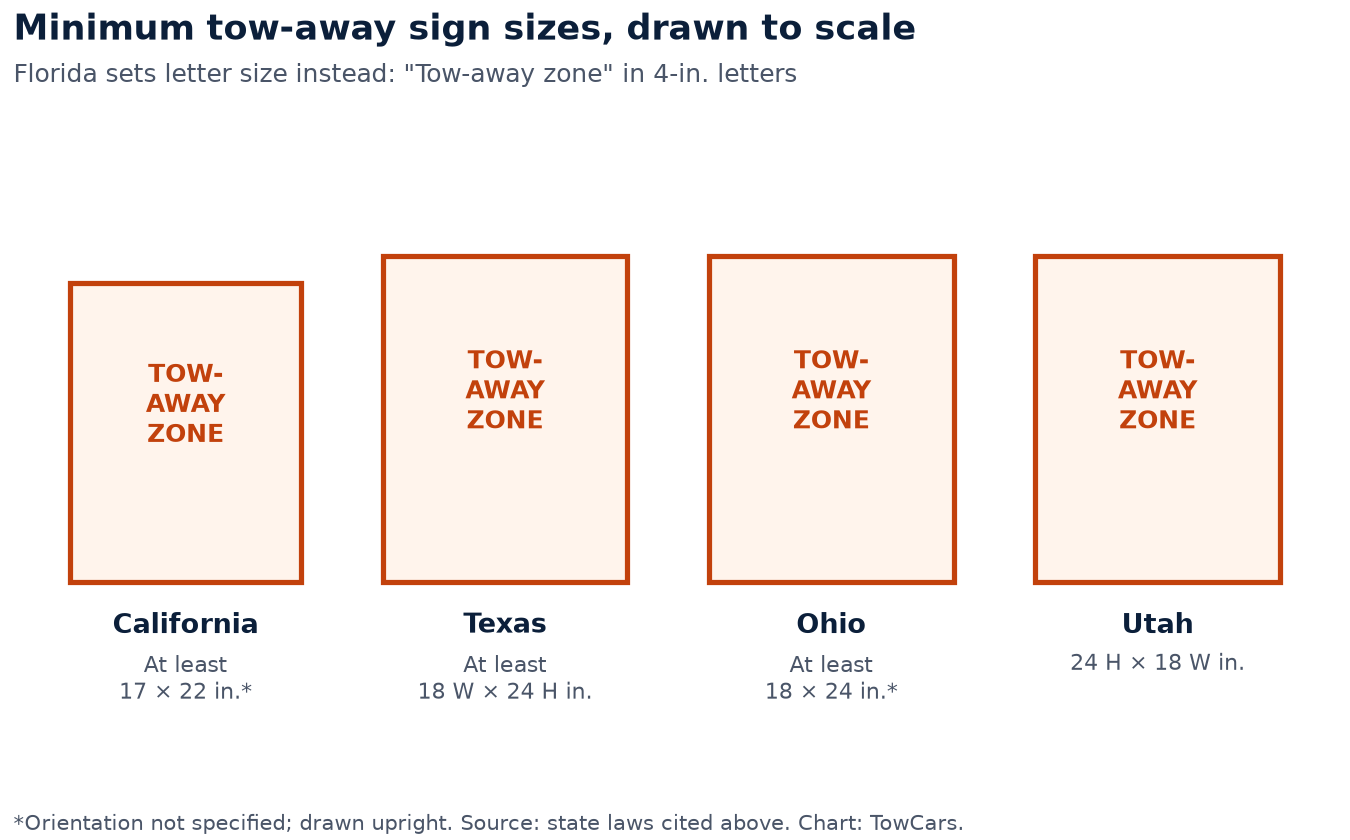
The short answer: Most states only allow a private-lot tow if the lot is properly signed. California requires signs at least 17 x 22 inches at every entrance. Texas and Ohio require at least 18 x 24 inches, and Florida requires “tow-away zone” in 4-inch letters. If the sign was missing or didn’t follow the rules, the tow may be illegal and you may be owed a refund.
Disclaimer: TowCars.com is a nationwide towing information and referral service. We don’t tow, dispatch, or store vehicles, and we don’t guarantee any towing company. If you send us a request, we pass it to independent providers who set their own prices and terms. See our disclosure.
When your car is towed from a store, apartment or office lot, the first thing to check is the sign. Many state laws spell out the size, location and wording of tow-away signs, and a tow from a lot without proper signs can be challenged. Here are the official rules, with links to each law.
Tow-away sign rules by state
| Place and rule | Key rule |
|---|---|
| CaliforniaIn plain view at all entrances. It must say public parking is prohibited and cars will be removed at the owner’s expense, and list the local police phone number plus the name and phone of each towing company. Source: Cal. Veh. Code §22658(a)(1) | At least 17 x 22 in., letters at least 1 in. |
| TexasAt each driveway or curb cut, facing drivers, bottom edge 5 to 8 ft above ground. Needs a red towing symbol, “Towing Enforced” in white on red, who may park, enforcement days and hours, and a 24-hour phone number. Source: Tex. Occ. Code 2308.301-.302 | At least 18 in. wide x 24 in. tall |
| FloridaAt each driveway or curb cut within 10 ft of the road (no curbs: one sign per 25 ft of frontage). 2-in. reflective letters saying unauthorized vehicles will be towed at the owner’s expense, plus the tow company’s name and phone. Posted at least 24 hours before a tow. Source: Fla. Stat. 715.07(2)(a)5 | “Tow-away zone” in 4-in. letters |
| OhioVisible from all entrances. Must say it’s a tow-away zone, who may park, enforcement times (if not 24/7), the phone and address where a towed car can be recovered day or night, and that failing to recover it may cost you the title. Source: Ohio Rev. Code 4513.601(A)(1) | At least 18 x 24 in. |
| UtahPatrolled lots need “Lot is Patrolled” and “Towing Enforced” signs plus a sign with who may park, the tow carrier’s name and phone, and tow.utah.gov. Without compliant signs, the owner must give 24-hour written notice on the vehicle. Source: Utah Code §72-9-603 | 24 in. tall x 18 in. wide |
| WashingtonFor nonresidential lots, no impound within 24 hours unless a sign near each entrance shows when cars may be impounded and the tow firm’s name, phone and address. Residential lots: immediate tow with written authorization. Source: RCW 46.55.070 | Times and tow firm on the sign |
| VirginiaMust clearly say unauthorized vehicles will be removed, towed or immobilized, and at minimum give the nonemergency number of local police or the tow operator’s number. Local ordinances can add rules. Source: Va. Code §46.2-1231 | Signs at all entrances |
| OregonA tower may not tow from a parking facility unless a sign in plain view, in clear and conspicuous language, prohibits or restricts public parking. The tower also needs signed authorization at the time of the tow. Source: ORS 98.854 | Clear sign in plain view |
| MassachusettsRemoval is allowed only where parking is forbidden directly or by posted notice. The person in control of the property must notify the police before the car is removed. Source: M.G.L. c.266 §120D | Posted notice and police notice |
| GeorgiaTariff rates apply only if the property posted notice that unauthorized vehicles will be towed, meeting DPS Rule 570-38-7-.14. Residential properties with four or fewer units are exempt. Source: GA DPS Tariff No. 5 (PDF) | Signs required to charge tariff rates |
When a sign isn’t needed
Signs aren’t the only way to make a private-lot tow legal. Common exceptions in these laws include:
- Fire lanes, hydrants and disabled spaces. Utah’s sign rules don’t apply to fire lanes, spaces within 15 ft of a hydrant, or disabled spaces. Texas allows a tow, without the usual sign, of a car in a marked fire lane or blocking an entrance or exit.
- Personal or written notice. Texas allows a tow if you got actual notice or a notice on the windshield followed by certified mail. Florida exempts cases where notice was given to you personally. California allows a tow after a parking notice has been on the car for 96 hours.
- Homes and small lots. California and Florida exempt single-family homes. Utah exempts single-family homes and duplexes. Florida businesses with 20 or fewer spaces can use a shorter “Reserved Parking for Customers Only” sign in 4-inch letters.
If the sign was wrong: what you can get back
- California: a property owner who breaks the sign and authorization rules is civilly liable for double the towing and storage charges (§22658(e)).
- Texas: a company or property owner that breaks the law is liable for your damages and fees. If the violation was intentional, knowing or reckless, it’s $1,000 plus three times the fees (Occ. Code 2308.404). Small variations in sign or letter height don’t count as violations (2308.407).
- Massachusetts: a tow company that doesn’t follow the rules must release the car without charging you (c.266 §120D).
How to check the sign (do this fast)
- Go back and photograph every entrance. Take wide shots showing where the signs are, plus close-ups of the wording. Texas lets you attach photos of the signs, or a statement that there were none, to your hearing request (2308.456).
- Measure if you can. Size, letter height and mounting height are all set by law in several states. A tape measure photo is strong evidence.
- Check the wording against your state’s list in the table above, including phone numbers and enforcement hours.
- Act on deadlines. In Texas you must request a hearing within 14 days (not counting weekends and holidays).
Next steps: our wrongful tow refund guide explains how to claim your money back state by state, and the free tow bill checker flags fees above the legal limit even when the tow itself was legal.
Stuck right now? Send a quick free quote request and we’ll connect you with an independent local tow provider. Ask for the full price before they dispatch.
Get a free quoteIndependent providers set their own prices. We don’t tow or store vehicles.
FAQ
Can I be towed from a private lot with no sign?
In many states, generally not without other notice. California, Texas, Florida, Ohio, Oregon and Utah require posted signs before most private-lot tows. Some have alternatives, such as Utah’s 24-hour written notice or Texas notice on the windshield followed by a mailed notice. Fire lanes, disabled spaces and blocked driveways usually don’t need a sign.
How big does a tow-away sign have to be?
California requires at least 17 by 22 inches with 1-inch letters. Texas requires at least 18 inches wide by 24 inches tall, Ohio at least 18 by 24 inches, and Utah 24 inches tall by 18 inches wide. Florida sets letter heights: 4 inches for “tow-away zone” and 2 inches for the main notice.
What phone number has to be on a tow-away sign?
It depends on the state. California requires the local police number plus each towing company’s name and phone. Texas requires a 24-hour number to locate the car. Ohio requires the phone and address where the car can be recovered. Florida and Washington require the towing company’s details.
What if the sign didn’t meet the rules?
You may be able to get your money back. In California, a property owner who doesn’t comply is liable for double the towing and storage charges. In Texas, a company that intentionally, knowingly or recklessly breaks the towing law is liable for $1,000 plus three times the fees. Texas lets you include photos of the signs when you request a hearing.
How long must a tow sign be posted before a tow?
Texas and Florida require signs to be up for at least 24 hours before a tow. Washington bars impounds from nonresidential lots within 24 hours unless a compliant sign is posted.
Rules change; verify with your local authority. Cities and counties can add their own sign rules. All details were checked against the official sources below in October 2026. This is general information, not legal advice.
Sources
About the Author