AI-generated illustration
The short answer: Often, yes. In California, lots storing cars from police tows (Vehicle Code 22651.1) and from private-property tows (Vehicle Code 22658(k)) must accept cash or a valid bank credit card, and laws in Texas, Nevada, Maryland, Virginia, New Jersey, Utah and New York City also require cards in many cases. Rules vary: Georgia leaves cards optional, while Utah and Colorado let companies add a card fee.
Disclaimer: TowCars.com is a nationwide towing information and referral service. We don’t tow, dispatch, or store vehicles, and we don’t guarantee any towing company. If you send us a request, we pass it to independent providers who set their own prices and terms. See our disclosure.
Getting towed is stressful enough without being told “cash only” at 11 p.m. The good news is that many states and cities require tow companies and storage lots to accept cards. Below are the official payment rules we found, then the places where cards are optional or cost extra.
Where tow companies must take cards
These rules come straight from state law, state regulators or city codes. Most of them cover private-property tows (from a store, apartment or office lot) and the storage lot where the car is held.
| Place and rule | Must accept |
|---|---|
| California (private-property tows)Storage lots must take a valid bank credit card or cash and post a notice saying so. Store-issued cards don’t count, and the card must be in your name. Source: Cal. Veh. Code §22658(k) | Cash or bank credit card |
| TexasStorage facilities must take all three for any delivery or storage fee. A tow driver must also take all three for the drop fee. Source: TDLR, TDLR consumer info | Cash, debit and credit |
| New York CityDCWP-licensed tow companies must accept a credit card. DCWP says not to accept “cash only.” Source: NYC DCWP | Credit card required |
| Chicago area relocation tows (ICC)Must be accepted without additional fees. Source: ICC guide (PDF) | Cash, money order, cashier’s or certified check, major credit card |
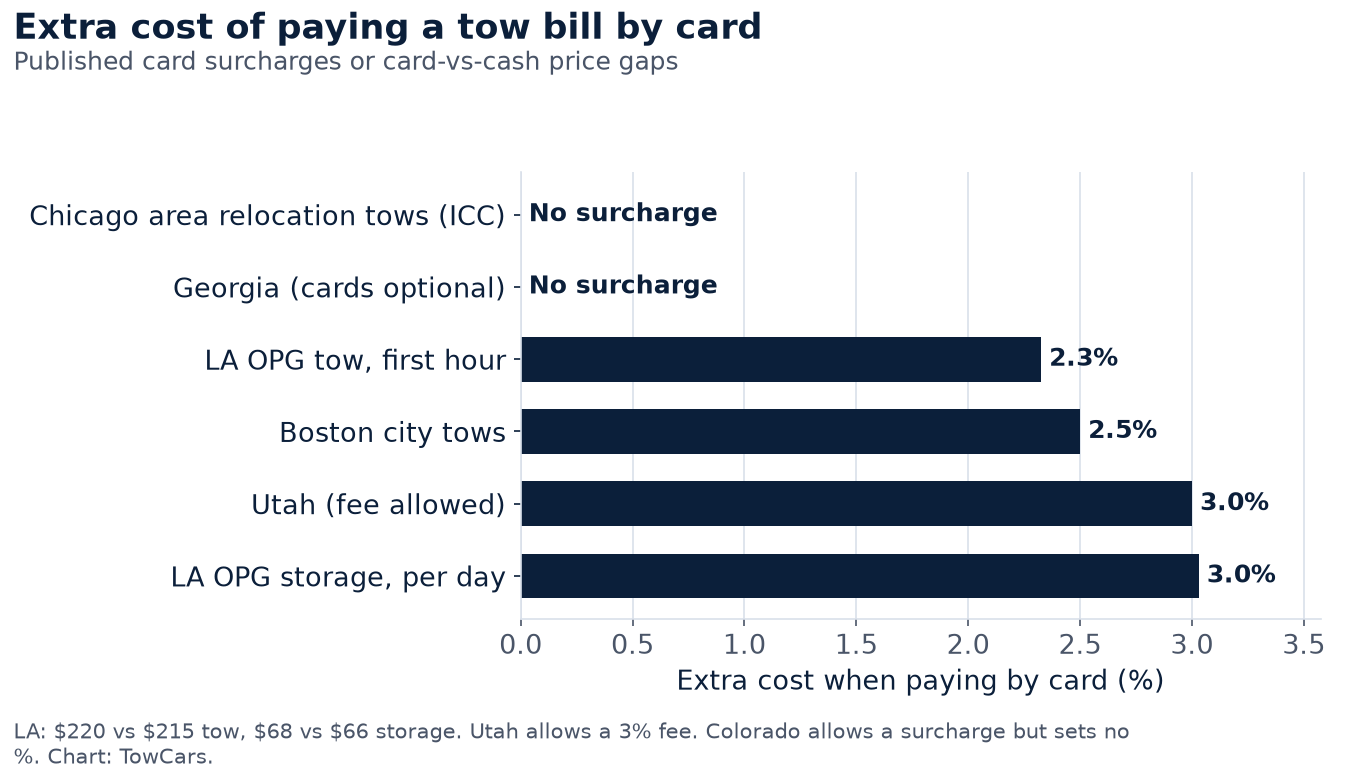
| UtahRequired for any tow service. A card processing fee of 3% of the total is allowed. Source: Utah Code §72-9-603, UDOT 2026 (PDF) | Cash and debit or credit |
| Portland, OR (private property impounds)Any valid Visa-branded card in the owner’s or agent’s name. If the card system is down, the tower must take personal checks. Source: Portland City Code 7.24 | Cash and Visa credit or debit |
| WashingtonTo redeem an impounded car, cash, major bank credit cards and personal checks on Washington bank branches (with two IDs) count as acceptable payment. Source: RCW 46.55.120 | Cash, major bank credit card or local check |
| Miami-Dade County, FLCash, money order, traveler’s check, bank, debit or major credit card, and since July 16, 2023, digital payments such as Zelle, PayPal, Venmo, Apple Pay or Cash App. Source: Miami-Dade Consumer Protection | Cash, cards and digital payments |
| Ohio (drop fee)The reduced drop fee can be paid by major credit card, unless the tow company uses a mobile card processor that has no service at that moment. Source: Ohio Rev. Code 4513.601(C) | Major credit card |
Where cards are optional or cost extra
| Place and rule | Rule |
|---|---|
| GeorgiaPayment may be made by cash, money order, certified or cashier’s check. Carriers that can take debit and major credit cards may do so at no additional charge. Source: GA DPS Tariff No. 5 (PDF) | Cards optional, no surcharge |
| ColoradoThe PUC says you can pay with cash, Visa or Mastercard, and companies may add a surcharge for credit card payments. Source: Colorado PUC, PUC rates | Cards accepted, surcharge allowed |
| San Francisco (SFMTA tows)The cardholder must be present with matching ID. No checks, phone or online payments. Source: SFMTA | Cash, ATM card, most credit cards |
| City of Chicago impoundsPersonal checks are not accepted. Source: City of Chicago | Cash, credit or debit card, USPS money order |
| Los Angeles (LAPD Official Police Garages)Standard tow: $220 for the first hour by credit card, $215 by other means. Storage: $68/day by card, $66 otherwise. Source: LAPD Police Commission (PDF) | Card costs slightly more |
| Boston (city tows)Boston lists a 2.5% fee if you pay by card. Source: Boston.gov | 2.5% card fee |
State-by-state: paying a tow or impound bill by card
The table above mostly covers private-property tows. Several states also have a general payment rule written into their statutes. We read each one on the official state legislature site in November 2026 and summarized it in plain English below. Each row links to the law itself.
| State and what the law says | Payment the lot must take |
|---|---|
| California (police and public tows)If your car went to a storage lot under the general police-removal law, the lot has to take cash or a valid bank credit card from the owner or the owner’s agent. The card has to carry the name of the person handing it over, and store-branded cards are excluded. A lot that turns down a valid card can owe the payer four times the tow and storage bill, capped at $500. Source: Cal. Veh. Code §22651.1 | Cash or bank credit card |
| Maryland (tows from parking lots)A storage lot holding a car towed from a parking lot must take cash or at least two major national credit cards. A cash-only lot needs a working ATM on site. If it can’t run a card and has no working ATM, it has to take a personal check, unless your card was declined. Source: Md. Transp. Code §21-10A-05(c) | Cash or two major cards (ATM or check backup) |
| NevadaTow car operators must take cash, money orders, credit cards, debit cards and electronic money transfers for towing services. They are allowed to give a discount for cash, but card payment can’t be refused. Source: NRS 706.44793 | Cash, money order, credit, debit, e-transfer |
| VirginiaA towing and recovery operator must take cash, an insurance company check, a certified check, a money order, or at least one of two widely used national credit cards. Very small operators (under $10,000 a year in towing income) can skip cards except on police-requested tows, but then must take personal checks. Operators also have to make change up to $100 for cash payers after a tow done without the owner’s consent. Source: Va. Code §46.2-118(B) | Cash, checks listed, or a major credit card |
| New JerseyTo release a car from storage, an operator must take cash, an insurance company check, a valid debit card, or a valid major credit or charge card. It can ask for extra ID and can refuse a card it has a real reason to think is fake, stolen, expired or fraudulent. Refusing a card it normally accepts is an unlawful practice under the Predatory Towing Prevention Act. Source: N.J.S.A. 56:13-4 and 56:13-16(g), P.L.2007 c.193 | Cash, insurer check, debit or major credit card |
Not legal advice. These are our own short summaries of each statute, not the official text. Laws and local rules change, and cities or counties may add rules of their own. Check the current law at the linked source, or ask a lawyer, before you rely on it.
Tip: if a lot in one of these states says “cash only”, calmly name the statute from the table, ask for the refusal in writing, and keep your receipt.
California’s rule has real teeth
California Vehicle Code §22658(k) says a storage facility holding a car from a private-property tow must accept a valid bank credit card or cash from the owner or the owner’s agent. It must also post a notice in its office saying all valid credit cards and cash are accepted, and keep enough money on hand to make change.
- Penalty: refusing a valid credit card, or not posting the notice, is a misdemeanor with a fine of up to $2,500, up to three months in jail, or both.
- Money back: a lot that breaks the rule is civilly liable to the person who paid for four times the towing and storage charges.
- Limits: the card must be in the name of the person presenting it, and cards issued by a retail store don’t count.
The City of San Diego’s towing rights sheet repeats the rule: a storage facility must accept valid credit cards and have enough cash on the premises to make change (San Diego (PDF)).
Paying the drop fee by card
If you catch the tow truck before it leaves, you can often pay a reduced “drop fee.” In Texas, TDLR says the tow truck driver must accept cash, credit cards and debit cards for the drop charge. In Ohio, the drop fee can be paid by major credit card unless the company’s mobile card reader has no service. Miami-Dade says you don’t need to pay the on-scene release fee in cash. See our full guide to drop fees by state.
What to do if they say “cash only”
- Point to the rule. Open the official source for your state or city from the tables above on your phone. In California, the lot must also post a notice in its office saying cards are accepted.
- Keep proof. If you end up paying cash to get your car back, ask for an itemized receipt and keep your ATM slip, so you can document what happened.
- Complain to the regulator. NYC: DCWP complaint form. Chicago-area relocation tows: ICC Police. Texas: TDLR complaints.
- Check the rest of the bill. A lot that breaks the payment rule may also be overcharging. Our tow bill checker compares each fee with the official cap, and our guide to daily storage limits shows what storage should cost.
Plan the pickup: total your yard charges with the impound release cost estimator.
Find the lot first: our impound lot directory lists official city impound lots, and the free tow bill checker flags fees above the legal limit. Think the tow itself was illegal? See how to get your money back.
Stuck right now? Send a quick free quote request and we’ll connect you with an independent local tow provider. Ask for the full price before they dispatch.
Get a free quoteIndependent providers set their own prices. We don’t tow or store vehicles.
FAQ
Does a tow company have to accept credit cards?
In many places, yes. California storage lots for private-property tows must accept a valid bank credit card or cash, Texas storage facilities must take cash, debit and credit cards, NYC-licensed tow companies must accept credit cards, and Utah requires cash and debit or credit. Rules differ by state and city, so check the official source for where you were towed.
Can a tow yard demand cash only?
Not in places that require card payments, such as California (private-property tows), Texas, New York City, Utah, Portland and Chicago-area relocation tows. In NYC, the consumer agency tells drivers not to accept “cash only” and to file a complaint if a tow company demands cash.
Can a tow company charge a fee for paying by card?
It depends on the place. Utah allows a 3% card processing fee and Colorado allows a credit card surcharge. Boston lists a 2.5% card fee, and LAPD garages charge slightly more by card. Georgia and Chicago-area relocation tows don’t allow an extra charge for card payments.
What happens if a California tow lot refuses my credit card?
Under Vehicle Code §22658(k), refusing a valid credit card or not posting the required notice is a misdemeanor, punishable by a fine of up to $2,500, up to three months in jail, or both. The lot can also be civilly liable to you for four times the towing and storage charges.
Can I use someone else’s card?
Not always. In California the credit card must be in the name of the person presenting it. San Francisco requires the cardholder to be present with matching ID, and Portland requires the card to be in the name of the registered owner or the owner’s agent.
Does a California police tow lot have to take credit cards?
Yes. Under Vehicle Code §22651.1, a storage facility holding a car removed under §22651 (the general police-removal law) must accept cash or a valid bank credit card from the registered owner, legal owner or the owner’s agent. The card must be in the presenter’s name, and store-issued cards don’t count. A lot that refuses a valid card can owe four times the towing and storage charges, up to $500.
Rules change; verify with your local authority. All details were checked against the official sources below in October 2026. This is general information, not legal advice.
Sources
- California Vehicle Code §22658
- City of San Diego: Your rights when towed (PDF)
- Texas TDLR: VSF fees and other charges
- Texas TDLR: Towing consumer information
- NYC DCWP: Towing
- NYC DCWP: File a complaint
- Illinois Commerce Commission: Relocation towing guide (PDF)
- ICC Police
- City of Chicago: Relocated / towed vehicle information
- Utah Code §72-9-603
- UDOT 2026 non-consent towing fee schedule (PDF)
- Portland City Code Chapter 7.24
- RCW 46.55.120
- Miami-Dade: Towing regulations
- Ohio Rev. Code 4513.601
- Georgia DPS: Non-consensual towing tariff No. 5 (PDF)
- Colorado PUC: Towing consumer information
- Colorado PUC: Towing rates
- SFMTA: Towed vehicles
- LAPD Board of Police Commissioners: OPG rates 2026 (PDF)
- Boston.gov: How to get your towed car back
- California Vehicle Code §22651.1
- Maryland Transportation Code §21-10A-05
- Nevada NRS 706.44793
- Code of Virginia §46.2-118
- New Jersey P.L.2007, c.193 (N.J.S.A. 56:13-4, 56:13-16)
Related: if you paid a tow bill that broke the rules, see how to get towing fees refunded. To check what a city lot can legally charge, use our tow and impound fees by city table, and read how to lower impound fees.
About the Author