AI-generated illustration
The short answer: Yes, in most places we checked. If you get back to your car before the tow truck leaves the lot, the law usually makes the driver release it for a reduced “drop fee” instead of the full tow. Caps range from $25 in Virginia and $62.50 in New York City to $135 in Texas, and California, Florida and Massachusetts limit it to half the regular tow charge.
Disclaimer: TowCars.com is a nationwide towing information and referral service. We don’t tow, dispatch, or store vehicles, and we don’t guarantee any towing company. If you send us a request, we pass it to independent providers who set their own prices and terms. See our disclosure.
This guide covers private-property tows: a car towed from a store, apartment or office lot at the property owner’s request. Police-ordered tows follow different rules. Every number below comes from a statute, regulator or official rate sheet, linked next to it.
Drop fees by state
| Place and rule | Max drop fee |
|---|---|
| VirginiaIf you remove the car before it is actually towed, it may not be towed. The fee can’t exceed $25 unless your city or county set a different limit. Source: Va. Code §46.2-1231(D) | $25 |
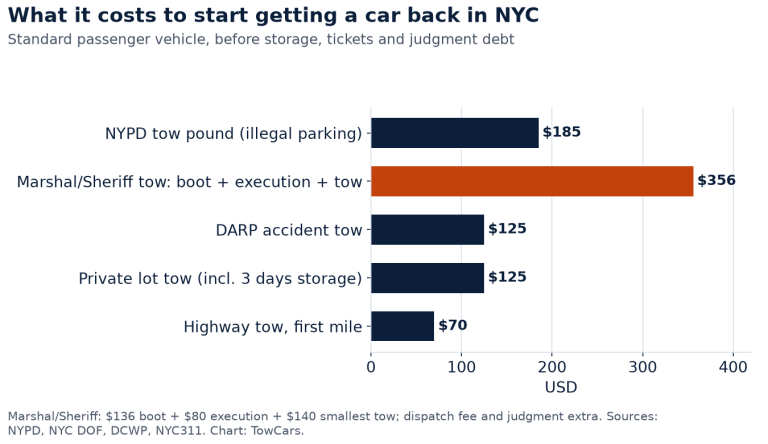
| New York CityDCWP “drop fee” for unhooking a car that is about to be towed from a private lot. Source: NYC DCWP | $62.50 |
| OhioHalf the $144 PUCO maximum tow fee for a light vehicle. The half-fee rule applies after the car is prepared for removal but before it leaves. Source: ORC 4513.601(C), OAC 4901:2-24-03 | $72 |
| Miami-Dade County, FLCounty “released on scene” drop rate for a Class A vehicle (rates effective Oct. 1, 2026). Source: Miami-Dade rate sheet (PDF) | $72.50 |
| ColoradoPUC maximum drop charge for a light vehicle. No drop fee at all on residential private property. Source: Colorado PUC | $97.70 |
| UtahMaximum drop fee in the 2026 UDOT non-consent fee schedule. Source: UDOT 2026 schedule (PDF) | $105.50 |
| Georgia“Operator fee” if the car is hooked up but hasn’t left and you drive it away (vehicles under 20,000 lb). Source: Georgia DPS Tariff No. 5 (PDF) | $130 |
| TexasTDLR maximum drop fee for a light-duty tow ($190 medium, $244 heavy). Source: TDLR | $135 |
| CaliforniaIf you return after hookup and before the truck leaves the property, the charge can be no more than half the regular towing charge. If the car isn’t hooked up yet, it must be released immediately and unconditionally. Source: Cal. Veh. Code §22658(g), (h) | Half the tow charge |
| FloridaThe tower must stop when you seek the car’s return and release it for no more than half its posted towing rate. Source: Fla. Stat. §715.07(2)(a)3 | Half the posted rate |
| MassachusettsIf you appear before the towing is completed, the tower may charge one half of the fee usually charged. Source: M.G.L. c.266 §120D | Half the usual fee |
| OregonRelease at no charge unless the hookup is complete. After hookup, the fee can’t exceed the listed hookup charge. Source: ORS 98.853 | $0 or the hookup charge |
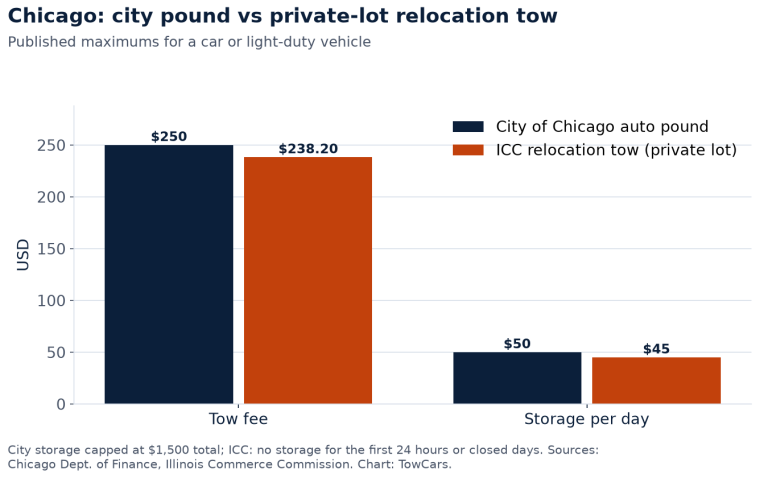
| Chicago area (ICC relocation tows)If you are there before the tow and offer to move the car, the tower must let you. Source: ICC consumer guide (PDF) | Not stated |
Ordered from lowest to highest dollar cap.
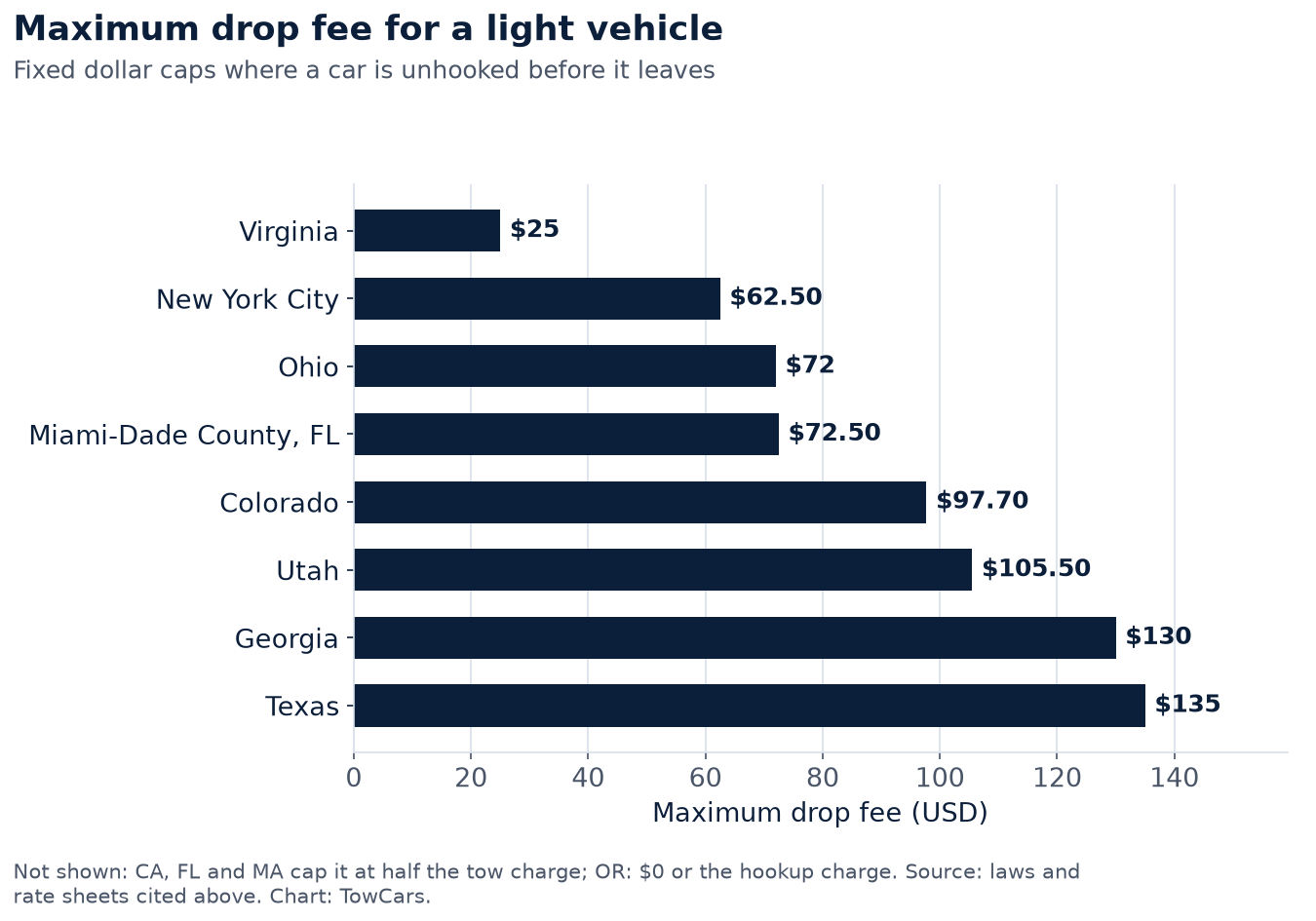
Not every state publishes a dollar amount. Where the rule is “half the tow charge,” the base is that company’s own posted or regular rate, so ask the driver what it is. To see what a full tow would have cost, compare these drop fees with the full private-tow caps in our 2026 report on the most expensive places to get towed.
When the drop rule kicks in
Timing matters. The rules usually split the tow into three moments:
- Before hookup. Oregon says the car must be released at no charge. California requires immediate, unconditional release of any car not yet removed from the property and in transit (§22658(g)).
- Hooked up, still on the property. This is the drop-fee window. California caps the charge at half the regular towing charge once the car is coupled to the truck or lifted off the ground (§22658(h)). Georgia calls it an “operator fee.”
- Off the property. In California, possession begins once the car is removed and in transit, and the full tow charge can be imposed only then. After that you’re paying the full tow plus storage.
What to do if you catch the tow truck
- Stay safe. Don’t stand between the truck and the car, and don’t try to drive off while the car is hooked up.
- Say clearly that you want the car released. Ask what the drop fee is.
- Pay only the drop fee and get a receipt. In Texas, the lot side of a tow must take cash, debit and credit cards (TDLR). NYC tow companies must accept credit cards (DCWP).
- Move the car right away. California requires you to move a released car to a legal spot immediately (§22658(g)(2)).
- Take photos. Photograph the signs, the truck’s company name and number, and the time. You’ll need them if you dispute the tow later.
If the driver refuses
In California, failing to release a car that hasn’t left the property is a misdemeanor, and overcharging can make the company liable for four times the amount charged (§22658(g)(1)(C), (j)). Ohio lists refusing to release a car for the half-fee as a “major” violation in its civil-action law. If you can’t settle it on the spot, call your local police non-emergency line. Then keep every receipt and follow our step-by-step guide on how to get your money back after a wrongful tow.
Already towed? Check the bill
Once the car is gone, the drop fee no longer applies. The tow fee, daily storage and any notice or after-hours fees then have their own caps. Our free tow bill checker compares each line of your bill with the official limits for 18 states and cities. You can also estimate a fair price for a normal tow with the tow cost calculator or find the right lot in our impound lot directory.
Stuck right now? Send a quick free quote request and we’ll connect you with an independent local tow provider. Ask for the full price before they dispatch.
Get a free quoteIndependent providers set their own prices. We don’t tow or store vehicles.
FAQ
What is a tow truck drop fee?
It is the reduced fee you pay when you get back to your car after the tow truck has hooked it up but before it leaves the property. Instead of a full tow, the driver unhooks the car and you pay the drop fee. For example, NYC caps it at $62.50 and Texas at $135 for a light-duty tow.
Can a tow truck driver refuse to release my car if I get there first?
In the places we checked, the law says no. California requires immediate, unconditional release of a car that hasn’t left the property yet, and refusing is a misdemeanor. Florida requires the tower to stop when you seek the car’s return, and the Illinois Commerce Commission says a relocation tower must let you move the car if you are there before the tow.
Do I have to pay a drop fee if the car isn’t hooked up yet?
Often not. Oregon requires release at no charge unless the hookup is complete, and California’s half-fee charge applies only after the car is coupled to the truck or lifted off the ground. Colorado bans drop fees on residential private property.
How much is a drop fee in Texas?
The TDLR maximum is $135 for a light-duty vehicle, $190 for medium duty and $244 for heavy duty.
What if the car was already towed away?
Then the regular tow and storage limits apply. Go to the lot quickly, because storage is charged per day, and check the itemized bill against your local caps with our free tow bill checker.
Rules change; verify with your local authority. All details were checked against the official sources below in October 2026. This is general information, not legal advice.
Sources
- California Vehicle Code §22658
- Florida Statutes §715.07
- Miami-Dade County maximum towing rates, eff. Oct. 1, 2026 (PDF)
- Texas TDLR: VSF fees and other charges
- Texas TDLR: towing consumer information
- NYC Department of Consumer and Worker Protection: Towing
- Code of Virginia §46.2-1231
- Massachusetts General Laws c.266 §120D
- Ohio Revised Code 4513.601
- Ohio Adm. Code 4901:2-24-03
- Oregon Revised Statutes ch. 98 (ORS 98.853)
- Colorado PUC: Towing rates
- UDOT 2026 non-consent towing fee schedule (PDF)
- Georgia DPS: Non-consensual towing tariff No. 5 (PDF)
- Illinois Commerce Commission: Relocation towing guide (PDF)
About the Author