AI-generated illustration
Can any car be towed? Almost always, yes, but not every car can be towed the same way. A vehicle’s weight, drivetrain, ground clearance, and powertrain (gas, hybrid, or electric) decide which towing method is safe and which one can quietly cause expensive damage. This guide explains vehicle weight terms in plain English, shows typical weights for common U.S. vehicles, clears up the confusion around towing capacity, and matches each vehicle type to the right towing method.
Why Vehicle Weight Matters for Towing
Weight affects which tow truck can safely carry or lift a car, how much stress goes into the hitch, tires, and suspension, and how long it takes to stop. A heavy pickup or electric SUV may be beyond what a light-duty truck or DIY trailer should handle. Weight distribution matters too: a front-heavy car behaves differently on a wheel-lift than one with a heavy battery spread across the floor.
Key weight terms
- Curb weight: what the vehicle weighs empty, with standard equipment and fluids but no passengers or cargo.
- Gross Vehicle Weight Rating (GVWR): the maximum the vehicle is designed to weigh when fully loaded, including passengers, cargo, and tongue weight from a trailer.
- Payload: how much weight you can add to the vehicle (people, cargo, tongue weight). Roughly GVWR minus curb weight.
- Towing capacity: the maximum trailer weight a vehicle is rated to pull when properly equipped.
- Gross Combined Weight Rating (GCWR): the maximum weight of the vehicle, its load, and the trailer together.
- Tongue weight: the downward force a trailer puts on the hitch. A common rule of thumb is about 10 to 15 percent of the trailer’s weight for conventional trailers, but follow your manufacturer’s guidance.
Where to find your vehicle’s numbers
Check the sticker on the driver’s door jamb (it typically lists GVWR and tire information), your owner’s manual, or the manufacturer’s website. Weight and towing figures change with trim, engine, drivetrain, and options, so use the numbers for your exact vehicle.
Typical Vehicle Weights in the U.S.
The ranges below are approximate and vary by model year, trim, and equipment. Use them as a general guide only.
| Vehicle type | Typical curb weight (approx.) | Common examples | Towing notes |
|---|---|---|---|
| Compact car | 2,600 to 3,100 lbs | Honda Civic, Toyota Corolla | Easy for most tow trucks; drivetrain still matters |
| Midsize sedan | 3,100 to 3,700 lbs | Toyota Camry, Honda Accord | Flatbed preferred; wheel-lift or dolly for some FWD models |
| Compact SUV / crossover | 3,300 to 4,000 lbs | Toyota RAV4, Honda CR-V | AWD versions usually need a flatbed |
| Midsize SUV | 4,000 to 5,000 lbs | Toyota Highlander, Ford Explorer | Often AWD; flatbed recommended |
| Full-size SUV | 5,400 to 6,500 lbs | Chevrolet Tahoe, Ford Expedition | Heavy; needs properly rated equipment |
| Light-duty pickup | 4,300 to 5,800 lbs | Ford F-150, Ram 1500 | Weight varies a lot by cab, bed, and drivetrain |
| Heavy-duty pickup | 6,500 lbs and up | Ford F-250, Ram 2500 | May need a heavier-duty tow truck |
| Electric sedan | 3,800 to 4,700 lbs | Tesla Model 3, Hyundai Ioniq 6 | Heavier than similar gas cars; flatbed usually recommended |
| Electric SUV / truck | 4,500 to 7,000+ lbs | Tesla Model Y, Rivian R1S, Ford F-150 Lightning | Very heavy; follow manufacturer towing procedure |
| Luxury sedan | 3,800 to 5,300 lbs | BMW 5 Series, Mercedes-Benz E-Class | Low clearance and costly bodywork favor flatbed |
Why EVs weigh more
Battery packs are heavy. An electric car often weighs several hundred pounds more than a similar-size gas car. That extra weight affects towing equipment choice, and the electric drivetrain adds its own rules, covered below.
Towing Capacity vs. Being Towed: Two Different Questions
People often mix up two questions:
- “How much can my vehicle tow?” That’s towing capacity, the trailer weight your vehicle can pull. It matters if you tow a boat, camper, or car trailer.
- “How should my vehicle be towed?” That’s about the towing method used when your car breaks down. It depends on drivetrain, weight, clearance, and condition, not on the car’s own towing capacity.
Towing capacity basics
Many compact and midsize sedans have low tow ratings or none at all for U.S. models. Crossovers and midsize SUVs are often rated for light-to-medium trailers, and full-size SUVs and pickups are built for the heaviest loads, with ratings that depend heavily on engine, axle ratio, and tow package. A heavier vehicle doesn’t automatically tow more; the rating depends on the frame, brakes, cooling, and hitch.
Leave a safety margin
Many drivers aim to keep the trailer well below the maximum rating, often around 80 percent, especially in hot weather or on long grades. In Southern California, that includes climbs like the Grapevine on I-5 or the Cajon Pass on I-15, where engines and transmissions run hot. And remember that passengers and cargo count against payload and combined weight limits.
Drivetrain: The Biggest Factor in How a Car Is Towed
Front-wheel drive (FWD)
The most flexible to tow. A wheel-lift or tow dolly that raises the front wheels is often acceptable, and a flatbed always is.
Rear-wheel drive (RWD)
Lift the rear wheels or use a flatbed. Rolling the rear drive wheels can damage the transmission unless the driveshaft is disconnected or the manual says it’s allowed.
All-wheel drive (AWD) and four-wheel drive (4WD)
With all wheels connected to the drivetrain, towing with two wheels on the ground can strain the center differential, transfer case, or AWD coupling. Flatbed is the safe default. Some 4WD vehicles with a neutral transfer case setting can be flat-towed behind an RV, but only following the manufacturer’s exact procedure.
Electric vehicles and hybrids
Many EVs have motors connected directly to the wheels. Spinning those wheels can generate electricity or harm the drive system, so most manufacturers recommend a flatbed. Many EVs also have a transport or tow mode that releases the parking brake for winching. Read the owner’s manual, and tell the towing company it’s an EV when you call.
Towing Methods Explained
Flatbed towing
- How it works: the bed tilts down, the car is winched or driven on, and it rides fully off the ground.
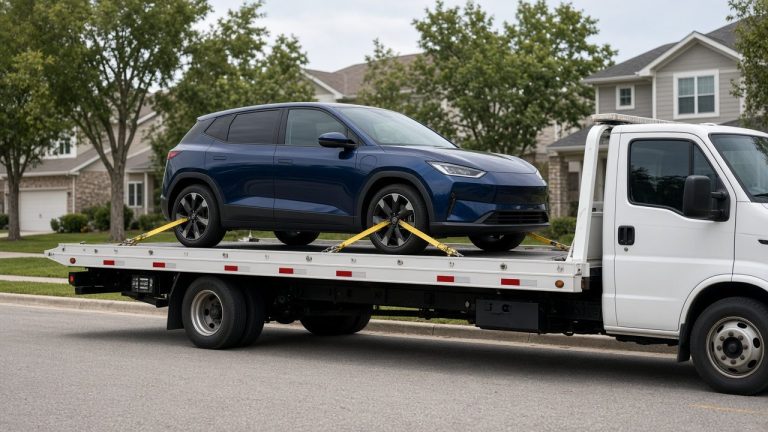
- Best for: AWD/4WD vehicles, EVs, luxury and low cars, accident damage, and longer tows.
- Pros: no wheel or drivetrain wear; the safest choice for almost any vehicle.
- Cons: often costs more; very low cars may need extra ramps to avoid scraping.
Wheel-lift towing
- How it works: a hydraulic yoke cradles two wheels and lifts that end of the car.
- Best for: short local tows of two-wheel-drive cars, tight spaces, and parking lots.
- Pros: fast hook-up and maneuverable.
- Cons: two wheels stay on the road; not suitable for most AWD vehicles or EVs.
Tow dolly
- How it works: a small two-wheel trailer lifts the front wheels; the rear wheels roll.
- Best for: front-wheel-drive cars over short distances, often in DIY moves.
- Pros: affordable and widely available to rent.
- Cons: wrong for RWD, AWD, and most EVs; steering, straps, and tow-vehicle rating must be right.
Car trailer
- How it works: all four wheels ride on a trailer pulled by a properly rated truck.
- Best for: non-running cars, project cars, and planned short moves.
- Pros: protects the drivetrain like a flatbed.
- Cons: the trailer and car together are heavy; the tow vehicle, hitch, and brakes must all be rated for the combined weight.
Flat towing (all four wheels down)
Used mainly behind RVs with a tow bar. Only certain vehicles are approved for it, and they must be set up exactly as the manufacturer describes. It is not a method for breakdowns.
Best Towing Method by Vehicle Type
| Vehicle | Recommended method | Special precautions |
|---|---|---|
| Compact FWD car | Flatbed, wheel-lift (front raised), or dolly | Check the manual; flatbed if unsure |
| Midsize sedan | Flatbed preferred | Confirm drivetrain before using a dolly |
| RWD car or sports car | Flatbed, or wheel-lift with rear raised | Protect low bumpers and spoilers |
| AWD crossover or SUV | Flatbed | Two-wheel towing can damage AWD parts |
| 4WD pickup | Flatbed or manufacturer-approved method | Transfer case position matters; don’t guess |
| Heavy-duty pickup or large SUV | Heavy-duty flatbed or wrecker | Confirm the truck is rated for the weight |
| Electric vehicle | Flatbed | Use transport or tow mode; follow the manual |
| Luxury or low-clearance car | Flatbed with low-angle loading | Use soft straps and extra ramps if needed |
| Accident-damaged vehicle | Flatbed in most cases | Check wheels, suspension, and leaks; may need winching |
Some of these vehicles deserve a closer look. See The Hardest Vehicles to Tow and Why They Need Special Care.
Safety Checklist Before Any Tow
- Check the owner’s manual for towing instructions, including EV transport mode and any distance or speed limits.
- Confirm the drivetrain (FWD, RWD, AWD, 4WD) and tell the towing company.
- Make sure the tow truck or tow vehicle is rated for your car’s weight.
- Take photos of all sides of the car before it’s loaded.
- Remove valuables, and note any existing damage.
- Release the parking brake and set the steering only as instructed.
- For DIY towing: check straps, chains, safety cables, lights, tire pressure, and trailer brakes, and drive slower with extra stopping distance. Our step-by-step guide on how to tow a car safely covers this in detail.
Common Mistakes When Comparing Weight and Towing
- Assuming a bigger vehicle can tow anything; the rating, not size, is what counts.
- Using the maximum tow rating for a differently equipped trim.
- Forgetting that passengers, cargo, and tongue weight count against limits.
- Towing an AWD vehicle or EV with wheels on the ground “just a short way.”
- Using a tow dolly on a rear-wheel-drive car.
- Ignoring accident damage like a bent wheel before moving the car.
Want to see how small mistakes turn into big repair bills? Read The Costly Towing Mistakes That Destroy Cars.
Frequently Asked Questions
Can any car be towed?
Nearly every car can be moved safely with the right method. When in doubt, a flatbed is the safe choice for almost any vehicle.
How do I find my car’s curb weight?
Check the owner’s manual, the manufacturer’s website, or a reputable spec listing for your exact year and trim. The door-jamb sticker usually shows GVWR, which is the loaded maximum, not curb weight.
Is curb weight the same as GVWR?
No. Curb weight is the empty vehicle. GVWR is the most the vehicle can safely weigh with people and cargo.
Can an AWD car be towed with two wheels on the ground?
Usually not without risk. Most manufacturers recommend a flatbed for AWD vehicles. Check your manual.
What’s the safest way to tow a Tesla or other EV?
A flatbed, following the manufacturer’s instructions for transport or tow mode.
Can a pickup truck be towed with a dolly?
Generally not. Most pickups are RWD or 4WD and too heavy for typical dollies. A flatbed or heavy-duty wrecker is the usual choice.
Does vehicle weight affect towing price?
Often, yes. Heavier vehicles may need larger trucks, which can cost more. For typical price estimates, see our guide to towing vs. car transport.
Can I drive a car after it was towed the wrong way?
If you notice new noises, warning lights, shifting problems, or vibrations, have it inspected before driving further.
Need a Tow in Los Angeles or the San Fernando Valley?
TowCars doesn’t tow cars ourselves. We connect drivers with independent local towing, junk-car buying, and car shipping companies. Send us a request with your vehicle details, and we’ll share it with providers serving your area so they can reach out with options. Mention your drivetrain and whether it’s an EV so they can send the right equipment.
About the Author