AI-generated illustration
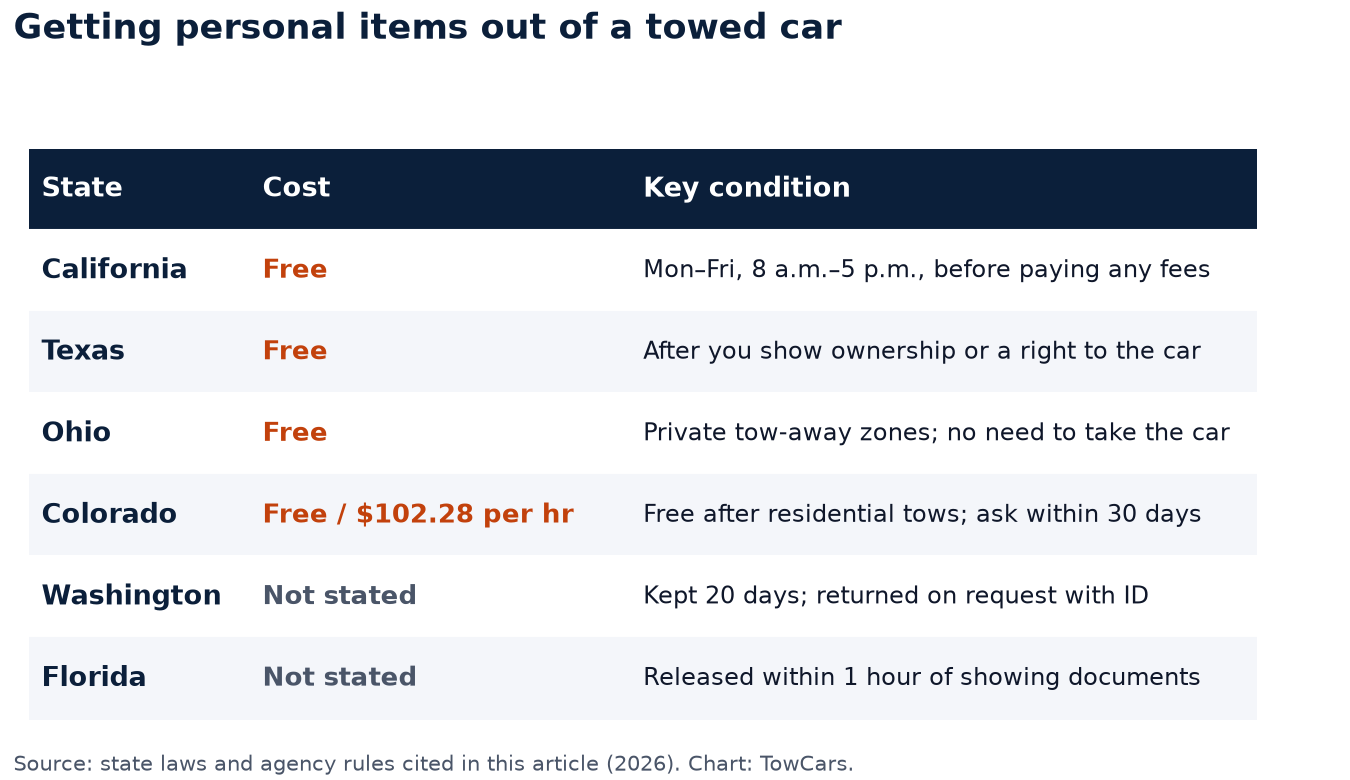
The short answer: In many states you can get personal belongings from a towed car without paying the tow bill first. California, Texas and Ohio (for private tow-away zone tows) let you take them free, at least during normal business hours. Colorado is free after residential tows. Bring a photo ID and proof that you own the car.
Disclaimer: TowCars.com is a nationwide towing information and referral service. We don’t tow, dispatch, or store vehicles, and we don’t guarantee any towing company. If you send us a request, we pass it to independent providers who set their own prices and terms. See our disclosure.
Your wallet, medicine, laptop or child’s car seat may be locked in a car at the tow yard. You may need them before you can afford to get the car back. Several states give you a right to your belongings, often for free. Here are the official rules, with links to each source.
Rules for getting personal items from a towed car
| Place and rule | Rule |
|---|---|
| CaliforniaBefore you pay any towing or storage fees, you can get your personal property at no charge, Monday to Friday, 8 a.m. to 5 p.m., except state holidays. No lien attaches to personal property in the car. After hours, a gate fee may apply, capped at half the hourly tow rate. Source: Cal. Veh. Code §22651.07(c)(1), §22851(b) | Free during normal business hours |
| TexasOnce you show ownership or a right to the car, the storage facility must let you remove personal belongings free of charge, unless law enforcement says otherwise. You sign a receipt listing what you took. A bill of sale can be enough to get your property, even though it isn’t enough to release the car. Source: TDLR: VSF vehicle access, TDLR consumer info | Free; no fee to release belongings |
| Ohio (private tow-away zones)With proof of ownership (title, registration or lease), you may retrieve personal items without retrieving the car and without paying any fee. Items attached to the car don’t count. If it’s unsafe, you may have to sign a liability waiver. Source: Ohio Rev. Code 4513.601(G)(4) | Free, without taking the car |
| ColoradoNo charge for property from a car towed from residential private property. Commercial private property and law-enforcement tows: up to $102.28 per hour. You must ask for it by 30 days after the tow company sends its statutory notice. Source: Colorado PUC towing rates | Free for residential tows; $102.28/hour otherwise |
| WashingtonBelongings must be kept intact for 20 days from impound and returned during normal business hours when you ask and show a driver’s license or other ID. You can sign a form to have them stored for 30 days. Otherwise, items left after 20 days are considered abandoned and can be sold with the car. Source: RCW 46.55.090(3) | Kept 20 days; returned on request |
| FloridaThe tow company must release all personal property not attached to the car within 1 hour after you show a qualifying document during normal business hours. Renters of a rental car get their own belongings within 1 hour of arriving. Source: Fla. Stat. 713.78(10) | Released within 1 hour |
What counts as personal property?
Things you can carry out of the car, like bags, phones, documents and clothing. Items attached to the car are a different story. Ohio excludes them (4513.601(G)(4)), Florida covers property “not affixed” to the car (713.78(10)), and Texas says you can’t remove or dismantle parts attached to the car (TDLR).
In Texas, if you need the title or registration to prove ownership, the storage facility must let you into the glove box or console to get it (TDLR).
How to get your belongings back
- Find the car. Call the number on the tow-away sign or search our impound lot directory.
- Call ahead. Ask for the hours to retrieve property and whether there’s any charge. In California, the free window is Monday to Friday, 8 a.m. to 5 p.m.
- Bring proof. A photo ID plus the title, registration or lease.
- Take everything you need. List what you remove. Texas facilities require a signed receipt.
- Don’t wait. Washington treats items left after 20 days as abandoned unless you file a storage request form.
- Report refusals. In Ohio, refusing to let you retrieve personal items is a major violation, and you can sue. The court awards $1,000 if the company had no other major violation within a year, plus three times any actual damages (Ohio Rev. Code 4513.611).
Next steps: find the lot in our impound lot directory, then run your receipt through the free tow bill checker to spot fees above the legal limit.
Stuck right now? Send a quick free quote request and we’ll connect you with an independent local tow provider. Ask for the full price before they dispatch.
Get a free quoteIndependent providers set their own prices. We don’t tow or store vehicles.
FAQ
Can a tow yard keep my personal belongings until I pay?
In many states, no. California says no lien attaches to personal property in the car, and you can get it free during normal business hours. Texas and Ohio also let you remove belongings without paying a fee. Check your state’s rule in the table above.
What do I need to bring to get my stuff out of a towed car?
Bring a photo ID and proof that you own or have a right to the car, such as the title, registration or lease. Texas says a bill of sale can be enough to get your belongings. Florida says one current government-issued photo ID is enough to verify identity.
Can they charge me to get my stuff?
It depends on the state. California, Texas and Ohio (for private tow-away zone tows) don’t allow a charge, at least during normal hours. Colorado charges nothing after residential tows but allows up to $102.28 an hour after commercial lot or police tows.
How long do I have to get my belongings?
Act fast. In Washington, belongings are kept 20 days from impound unless you sign a storage request form for 30 days. In Colorado, you must ask by 30 days after the tow company sends its notice.
Can I take parts off the car, like the stereo or tires?
Usually no. Ohio excludes items attached to the car, Florida covers property not affixed to the car, and Texas says you don’t have the right to remove or dismantle any part attached to the car at the storage facility.
Rules change; verify with your local authority. Cities and counties can add their own rules. All details were checked against the official sources below in October 2026. This is general information, not legal advice.
Sources
About the Author